

Search is changing faster than at any point in the past two decades. Since Google rolled out AI Overviews globally and large language models became part of everyday search behavior, marketers have been inundated with headlines declaring the death of SEO, the collapse of organic traffic and the end of the click.
Some of those headlines are rooted in truth. Others mistake a shift in behavior for the end of a channel.
To understand what is actually happening, we analyzed GA4 data across 54 clients spanning 19 industries and multiple global markets, comparing the eight months before AI Overviews became commonplace with the eight months after. Rather than looking at isolated case studies or individual websites, we wanted to understand how search behavior is changing at portfolio scale and, more importantly, what that means for SEO strategy moving forward.
The results confirm that organic traffic is under pressure. But they also reveal something equally important: AI is creating a new discovery channel whose visitors behave differently from traditional search users. That distinction matters because it changes how marketers should measure success in the age of AI.
Yes, organic traffic is declining
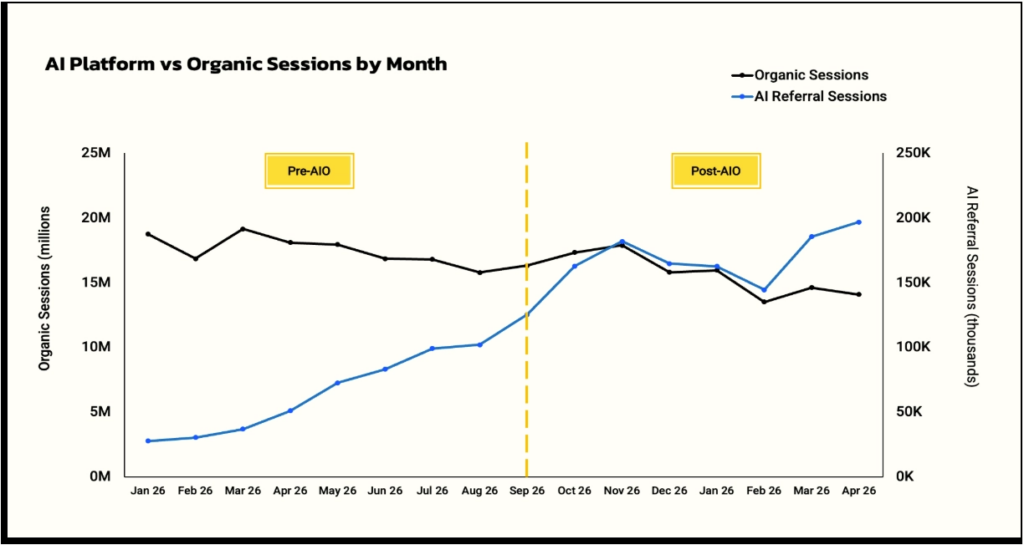
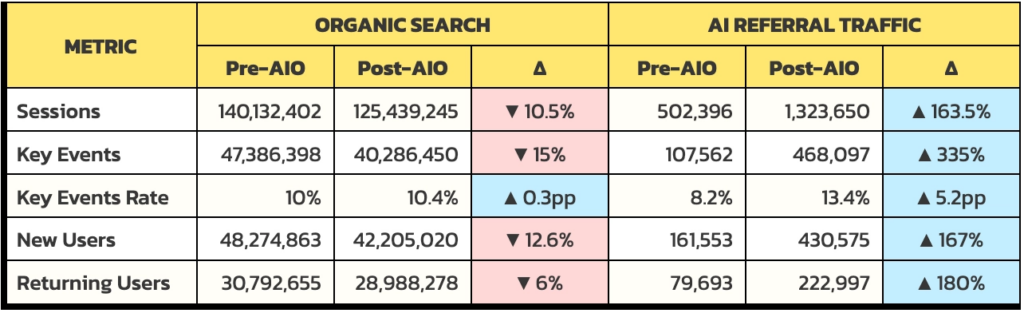
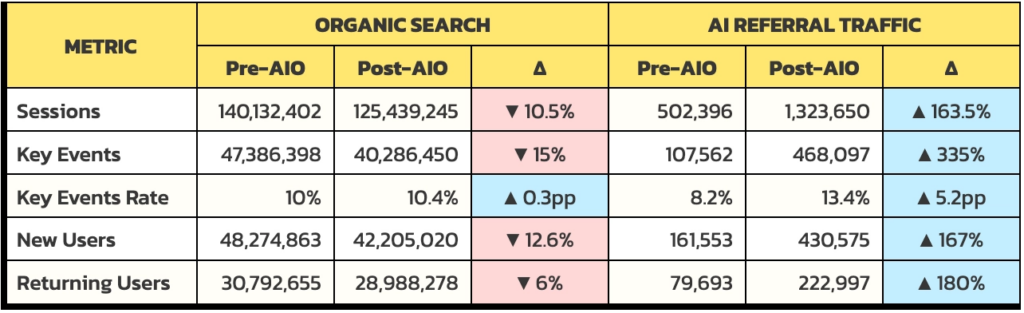
The data leaves little room for debate. Comparing the eight months before September 2025 (we used this as the inflection point with the eight months after, organic sessions across our client portfolio declined by 10.5%, falling from 140.1 million to 125.4 million sessions. The trend was remarkably consistent, with 46 of the 54 clients in our dataset recording declines over the same period. We used September 2025 as the inflection point for the analysis because, by that date, roughly 30% of US desktop keywords were triggering AI Overviews.
This reflects a broader change in how people interact with search engines. AI-generated answers increasingly satisfy informational queries before a user ever needs to visit a website. Instead of clicking through multiple results to build an answer themselves, users are often presented with a synthesized response at the top of the page. As those answers become more comprehensive, fewer searches naturally translate into website visits.
The implication is not that SEO has stopped working. Rather, the journey between asking a question and visiting a website has fundamentally changed. Traditional SEO metrics continue to capture what happens once someone clicks, but they reveal far less about the growing number of users whose research begins and ends inside an AI-generated response.
AI referral traffic is growing rapidly, but it isn’t replacing organic
This is where much of the current conversation becomes oversimplified.
AI referral traffic is growing extraordinarily quickly. Across the same comparison period, sessions arriving from AI platforms increased by more than 163%, while AI-driven key events grew by 335%.
Despite that rapid growth, AI referral traffic remains relatively small in absolute terms. Organic traffic declined by almost 14.7 million sessions across our dataset. AI referrals increased by just under 800,000 sessions over the same period, offsetting only around 5% of the organic traffic that disappeared.
That distinction is critical. AI platforms are not replacing Google search traffic one-for-one. Instead, they are becoming an additional layer within the discovery journey.
For marketers, this means resisting two equally misleading narratives. The first is that SEO is dead because traffic is falling. The second is that AI referrals will simply replace those lost clicks. Our data supports neither conclusion. Search is evolving into a more fragmented ecosystem in which brands need to earn visibility across both traditional search results and AI-generated answers.
The visitors arriving from AI are different
While AI referral traffic remains relatively small today, its quality is arguably the most interesting finding in our analysis.
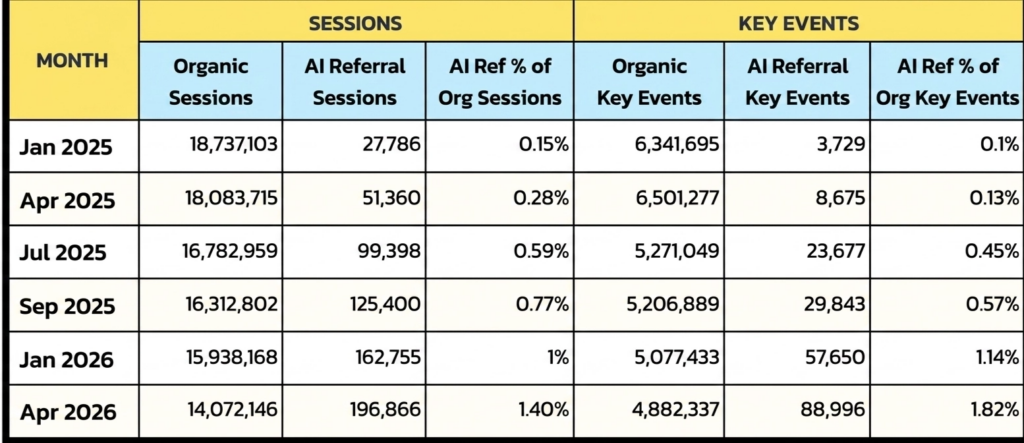
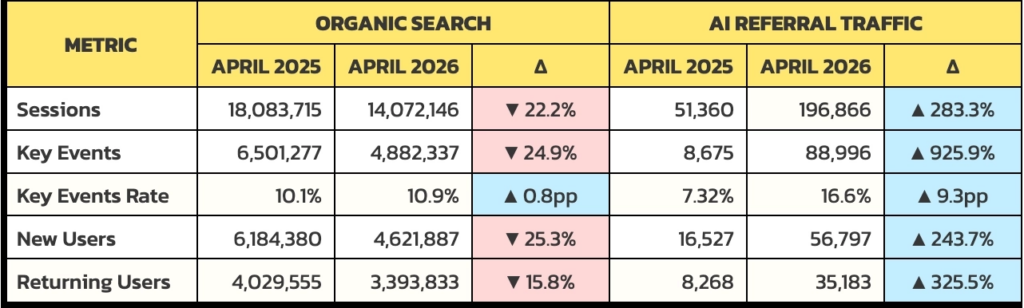
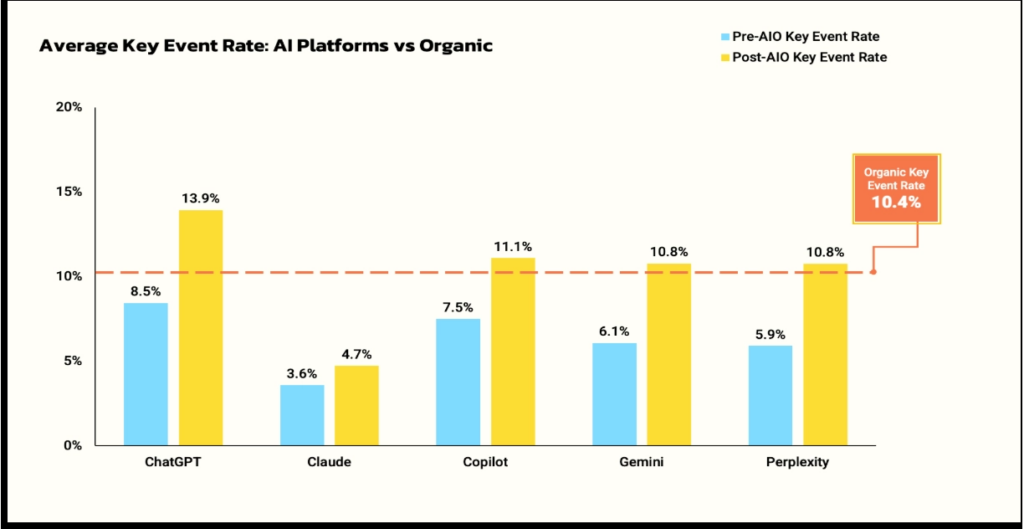
Across the post-AI Overview period, visitors arriving via AI platforms consistently generated higher key event rates than visitors from organic search. AI referral traffic reached a key event rate of 13.4%, compared with 10.4% for organic search. By April 2026, that gap had widened further, with AI referrals converting at roughly one and a half times the rate of traditional organic visitors.
This should not necessarily be interpreted as AI traffic being inherently “better”. Rather, it suggests these users may arrive at websites having already completed a greater proportion of their research. AI answers help users compare products, evaluate options and build confidence before they ever decide to click through to a brand’s website.
In other words, AI appears to be changing not just how users discover brands, but when they choose to visit them. The click increasingly happens later in the decision-making process, after much of the exploratory work has already taken place.
For marketers, that means measuring traffic volume alone provides an increasingly incomplete picture of search performance.
Not all AI platforms are contributing equally
The growth in AI referrals is also being driven by a changing mix of platforms.
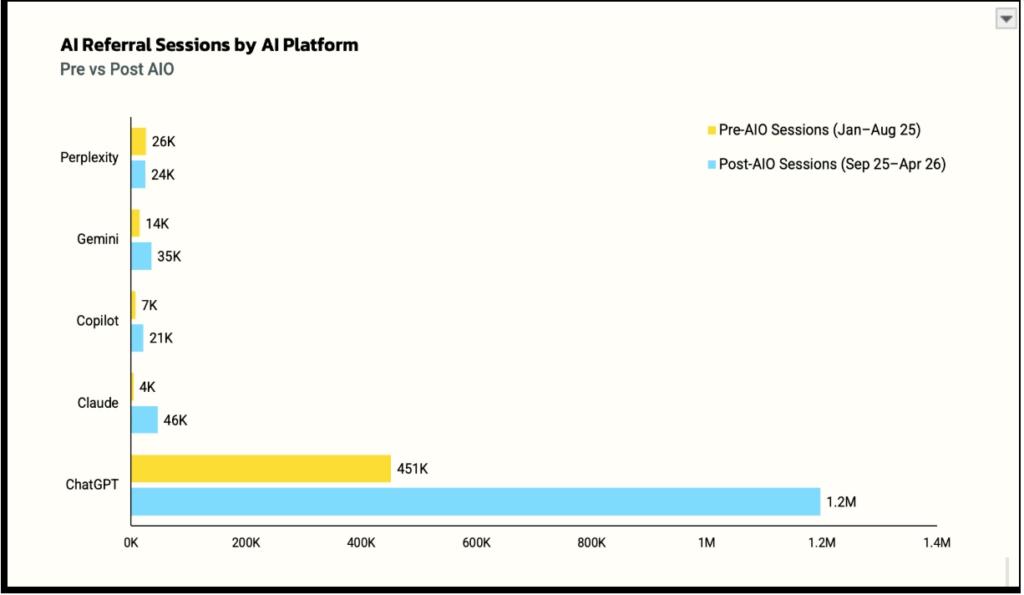
ChatGPT remains the dominant source of AI referral traffic within our dataset, accounting for the vast majority of AI-driven sessions while also improving its key event performance over time. Other platforms, including Claude, Gemini, and Microsoft Copilot are also growing, although from much smaller starting points.
This reinforces an important point. AI search is not a single platform or channel. Discovery is becoming distributed across multiple AI experiences, each with its own audience behaviors, citation patterns and referral dynamics.
Optimizing for AI therefore cannot mean optimizing for one platform alone. Brands increasingly need to understand how they are being represented consistently across the broader AI ecosystem.
The next evolution of SEO measurement
Perhaps the most important conclusion from this analysis has little to do with declining sessions or growing AI referrals.
It is that the traditional SEO measurement framework is no longer sufficient on its own. Standard SEO metrics still show whether traffic is up or down. What they don’t show is whether a brand is gaining or losing ground inside AI-generated answers themselves, the citations, summaries, and recommendations that never produce a click at all. That’s the real measurement gap right now, and it’s why this analysis, built entirely on GA4 session data, is really the first half of the picture.
The other half is AI visibility: where a brand gets mentioned, cited, or recommended across AI platforms, and how third-party coverage, reviews, video, social, and creator content feed into that. A brand can be losing organic sessions while still gaining ground in how AI platforms describe and recommend it, or the reverse. Traffic data alone can’t tell the difference.
The practical shift for brands and their SEO teams is to stop treating AI referral traffic as a rounding error in the search report and start tracking it the way any other channel gets tracked: its own sessions, its own conversion rate, its own platform mix, watched over time alongside AI visibility signals. Most teams are already measuring pieces of this. The next step is doing it consistently, so investment decisions, what content to build, where to strengthen entity data, where third-party authority matters, are grounded in where AI platforms are actually sending attention, not just where Google search used to send it.