

Following on the exciting announcements of Google I/O, Google revealed their vision for the future of marketing at a festival-themed Google Marketing Live 2026 (complete with plenty of Daft Punk references). If you’ve worked even vaguely within the vicinity of performance marketing over the last few years, you could have taken a pretty good bet at what the key themes were likely to be coming out of the 2026 edition of Google Marketing Live:
“The role of Search is transforming across the purchase journey”
“Continuing to elevate the role of AI in your performance campaigns”
“Powering the move to agentic commerce”
“Empowering marketers to move from conversation to action with agentic solutions”
“Driving both upper- & lower-funnel objectives with YouTube”
“Leveling up your media measurement solutions”
The core theme behind all the announcements: “Google search is AI search.” GML 2026 unveiled novel product innovations to continue driving this transition. We’ve spotlighted our favorite tools below, whether it’s a case of using AI to enable marketers to become more strategic, providing new tools with which to connect your business priorities to Google Ads, or preparing for the world of infinite creative.
Becoming more Strategic with AI
Knowledge work has changed considerably in the last two years. Marketers who used to rely entirely on platform-native tools now arrive at their desks with a Claude or ChatGPT window already open. They brief AI in plain language, use it to shape messaging, test creative concepts, and think through audience strategy. The announcements in this theme are Google’s recognition of that shift: products designed to meet marketers where they already are, rather than asking them to learn a new interface.
Ask Advisor
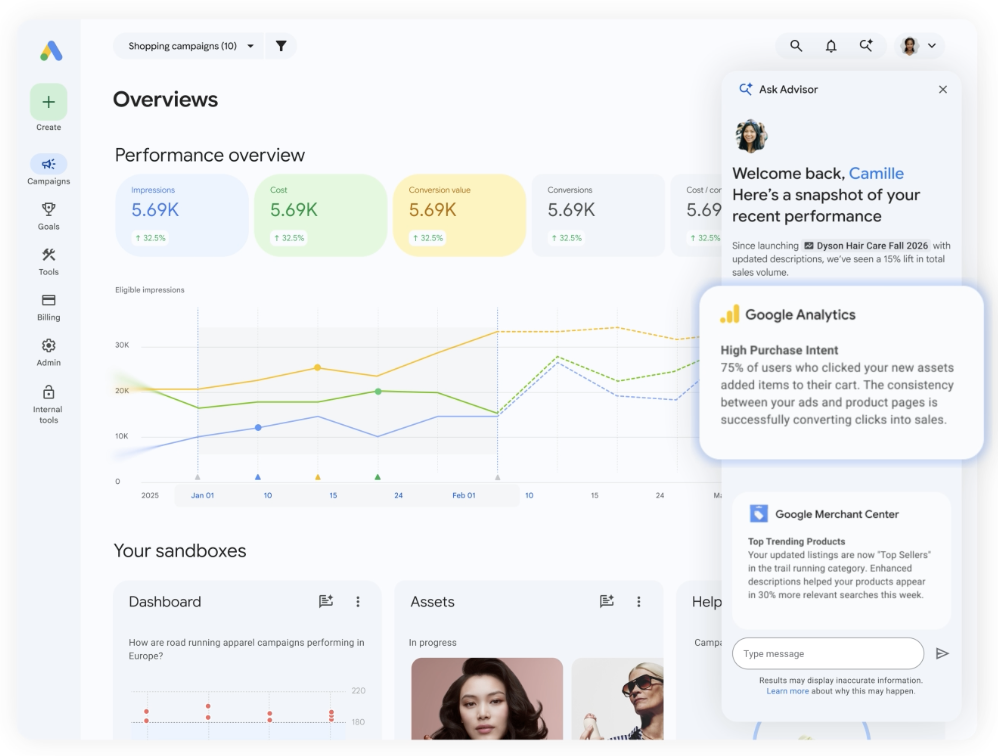
An agentic conversational interface that spans Google Ads, Google Analytics, Google Marketing Platform, and Merchant Center. By connecting specialized agents embedded in each of these pieces of the Google advertising and measurement ecosystem, Google is providing a new interface for advertisers to analyze their marketing strategies and identify opportunities from a holistic perspective.
Google has been working to build this conversational functionality into ads management for nearly three years, but the current conversational interfaces are isolated within each portion of the ecosystem. If Ask Advisor truly functions as described, it will be a fantastic way for advertisers to diagnose issues, surface insights, and identify opportunities. Historically, connections between these elements of the Google ecosystem happened entirely on the back-end. By providing a new entry point for us to engage with all of these pieces at once, Google is meeting advertisers where they operate today – in a chat experience powered by connected agentic advisors.
AI Brief
According to Phillipp Schindler, Chief Business Officer, “Google is firmly in our Gemini Agentic Era,” and that functionality is coming to Google Ads. AI Brief is a new way to guide AI Max (and eventually Performance Max) campaigns using natural language rather than settings and toggles. Advertisers write a description of their brand — what to say, what to avoid, which audiences to prioritize, how the tone should feel — and Google uses that as context to populate the text guidelines that generates ad copy. Think of it as a brand brief for Gemini: the same kind of instruction you’d give a copywriter or a media planner, now going directly into the campaign.
This is easily the top dog of this year’s new product releases. For years, Google’s prevailing narrative around AI has been twofold, in that it will (a) accelerate business performance, and (b) create efficiencies, so that you can focus your time on more strategic work.
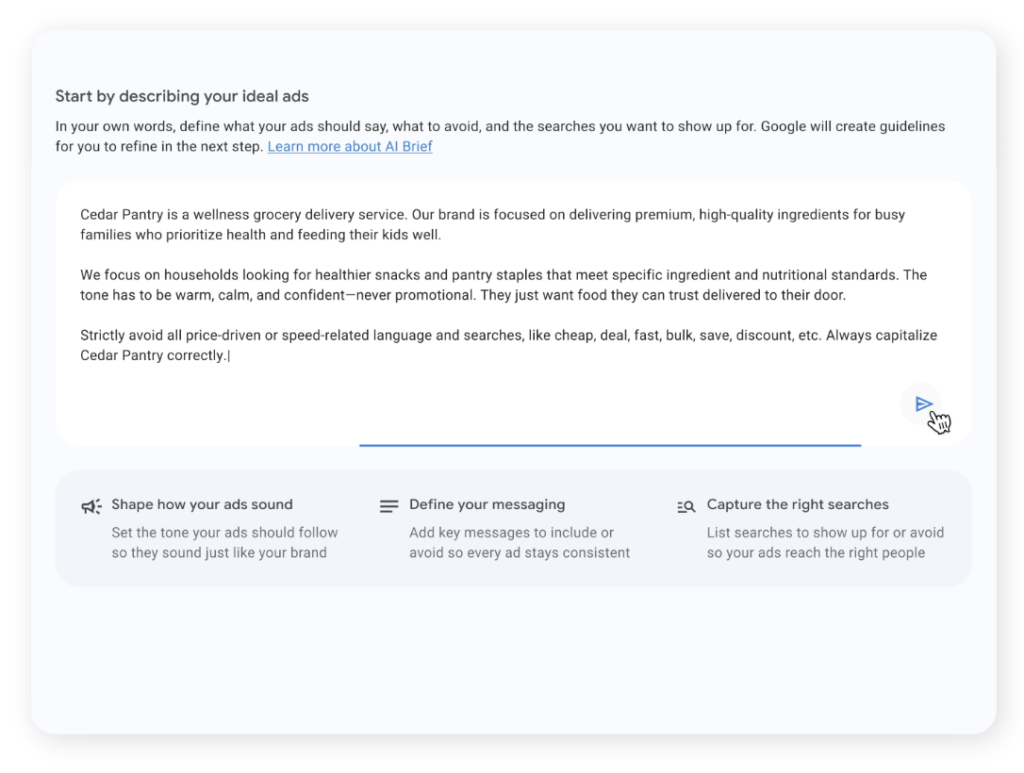
What they’ve never made exactly clear, is precisely what that strategic “stuff” is – until now. For the first time, AI Brief is going to establish a direct causal relationship between your ability to articulate the needs of your customers and your brand proposition, and the subsequent performance that you can achieve through your campaigns. Brief writing will be a genuinely new skillset for paid search practitioners to master.
What’s more is that, assuming AI Brief is released as a campaign-level setting, it will now be possible to run an A/B test not just between different variations of your ad copy – but between different variations of your overarching brand proposition. This will not only be a huge unlock for campaign performance, but also promises to be able to answer a question of huge strategic value to any business: “which proposition is resonating the best within the market?”
It’s also interesting to speculate as to where AI Brief could head in the future. For now, AI Brief is primarily a creative tool, a way of telling Gemini how to write, what to say, what to avoid. But this same technology could also extend to influence bidding and targeting as well. There could be a future world in which your brief includes “my most profitable customers have XYZ traits”, and then Google AI is able to hone in on those customers without necessarily requiring the technical overhead of customer match lists, or value-based bidding implementation. It’s early thinking that needs more development, but it’s the direction worth watching.
AI Max for Shopping Campaigns
AI Max for Shopping is a one-click toggle that brings AI Max capabilities to existing Shopping campaigns. Standard Shopping campaigns match ads to queries by reading product feed attributes: titles, descriptions, categories. AI Max removes that constraint, allowing the campaign to respond to natural language and conversational queries that wouldn’t match any feed attribute directly. Google describes it as a way to capture long-tail demand that standard Shopping campaigns are structurally unable to reach.
There are two questions buried inside this announcement, and it’s worth separating them because they have very different answers.
The first is whether you should apply AI Max to your existing Shopping campaigns. Given how search behavior has shifted toward more conversational, natural language queries, the answer is close to a no-brainer. If your standard Shopping campaigns are leaving long-tail demand on the table because the feed can’t match it, AI Max is a straightforward fix. For most advertisers running regular Shopping campaigns, this should be on the implementation list.
The second question is harder: once you’ve enabled AI Max on Shopping, where does that leave Performance Max? PMax is also supposed to capture everything standard Shopping misses, including conversational and long-tail queries within shopping inventory. If both products are now theoretically doing the same job, advertisers need a clear framework for when to use which. Google hasn’t provided one yet. Until they do, our recommendation is to test AI Max on Shopping campaigns where you have a clear baseline, watch what it finds, and treat the PMax question as genuinely open.
Communicating your Business Goals with Better Data
While we can speculate upon the future applications of AI Brief, what remains true for now is that any effective performance media program relies upon high quality data inputs. In a digital environment that continues to become increasingly hostile to third-party tracking, your first-party data is the means through which you communicate your business objectives to Google.
Consumers move seamlessly between channels and experiences, which has always led to tracking challenges. Yesterday at Google I/O, Google announced their new Universal Cart – a single, persistent shopping cart spanning Search, YouTube, Gmail, and Gemini. In addition to connecting the consumer shopping experience, Universal Cart is poised to be a massive opportunity for advertisers – not just improving the quality of signals coming in, but ensuring more of the purchase journey happens within an environment where those signals are captured cleanly in the first place.
Every key feature in this cluster addresses the same underlying problem: the signals going into Google’s automated systems are often incomplete, misaligned with actual business goals, or technically leaky. The tools announced here are Google’s answer to that. And to their credit, they’re real answers, not just repackaging.
Google Tag Gateway
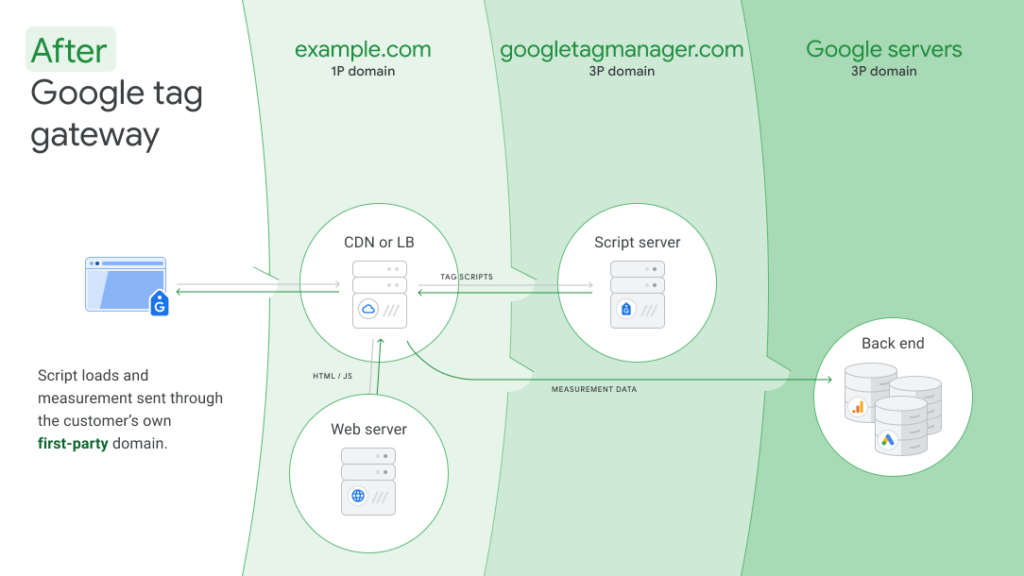
Google Tag Gateway (GTG) enables better conversion tracking by routing your tag signals through your own domain’s server rather than through Google’s infrastructure directly. For any advertisers familiar with the Conversions API, a functionality available in another popular ad tech platform (which shall go unnamed), GTG is meant to solve similar data loss challenges using a different approach.
The practical effect is better data accuracy, higher match rates, and first-party data that’s more resilient to browser-level tracking restrictions. Importantly, and this is the part Google leads with, it requires no changes to existing tag code. You upgrade the infrastructure without touching a single line on your site.
GTG isn’t new. Google has been pushing it for some time. But the GML announcement is framing it as newly accessible for agencies, with one-click implementation built in. That’s meaningful because the adoption barrier has always been technical friction on the client side. We’ve written about this before and have been actively implementing it for clients, and Google even invited Brainlabs to co-present multiple trainings for other agencies about this product. The more interesting question this year isn’t whether GTG is good (it is), but whether Google has genuinely lowered the barrier enough to drive mass adoption. If they have, the data quality gap between early adopters and late movers is about to widen significantly.
The link to Confidential Matching, which came up at GML 2025, is also worth flagging: GTG provides 11% more signals through that program. For clients where customer match is central to the strategy, that’s a direct performance unlock.
Product Value Adjustments
Through Product Value Adjustments (PVAs), advertisers can apply multipliers to the conversion values of specific products within their catalogue, meaning that ecommerce advertisers can bid more aggressively on any SKUs of their choosing within their Shopping and Performance Max campaigns. You do this without touching the structure of your campaigns.
Technically speaking, this isn’t an entirely new capability. Sophisticated advertisers will already have in place mechanisms through which they can influence and override the conversion value data that is sent to Google. However, from everything we learned at GML, the real value of PVAs is in their ease of application. Rather than having to invest time into thinking about the technical practicalities of modifying conversion value data in an offline or server-side environment, PVAs will allow advertisers to modify conversion values directly within Merchant Center / Google Ads; a process which promises to be incredibly straightforward.
Eagle-eyed PPCers may question how this feature differs from Profit Optimization bidding, announced at last year’s GML. Compared to Profit Optimization bidding, PVAs are not only more straightforward to implement, but they are also much more generalizable; instead of just optimizing towards high-margin products, PVAs unlock a practically unlimited number of applications, such as:
- Upweighting conversion value against products which are known to drive higher repeat-purchase rates;
- Deprioritizing products which see the highest return rates;
- Accelerate sales of overstocked SKUs to balance inventory levels;
- Or any combination of the above
Welcome to the World of Infinite Creative
The creative announcements in this section don’t stand alone. Sitting underneath them is Gemini Omni Flash, Google’s most capable multimodal model, confirmed for Google Ads this summer. It’s built to take “any input” and produce “any output”: text to video, image to copy, brief to campaign. That’s the infrastructure that makes “infinite creative” function. Asset Studio is the interface, but Gemini Omni Flash is what makes it possible.
Asset Studio
Asset Studio is Google’s unified creative workspace inside Google Ads: a place to generate, test, and manage creative assets using Google’s most powerful AI models. The key update in 2026 is the introduction of multimodal capabilities: advertisers can now generate both images and video content by describing what they need in plain language, pulling in existing brand materials and marketing briefs to keep output on-brand. There’s also a one-click A/B testing flow built directly into the creation process.
Asset Studio has been around for a while. It was mentioned at GML 2025 as a “unified creative destination.” Upon initial launch, it’s fair to say that the tool struggled to match up to advertiser expectations.
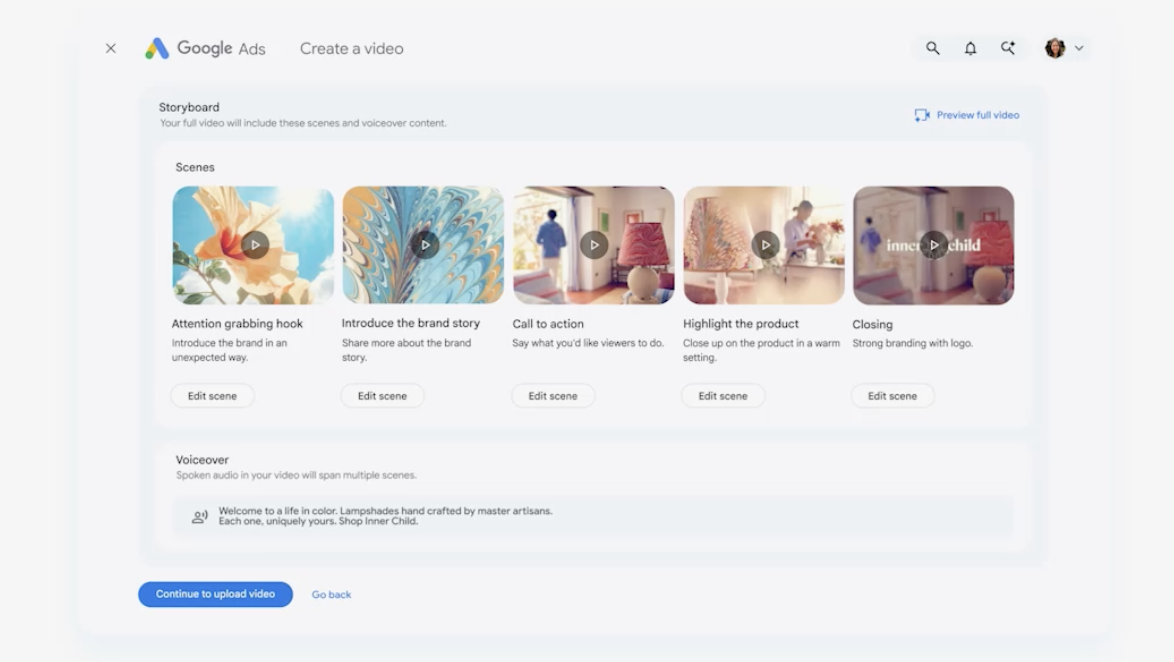
What would make the 2026 version genuinely exciting is more consistency in the quality of generated assets, as well as the video generation capability – which would genuinely be net new. On-brand image generation has been available in various forms for a while; video at campaign scale is a different proposition.
The one-click testing flow is worth paying attention to. Creative testing has long been an area where there’s a real gap between what most advertisers do and what they should. Most either skip it entirely or run tests too informally to get reliable results. If Asset Studio makes structured creative experiments genuinely easy to run, that changes the conversation around how creative strategy gets done.
The outstanding question is whether “brand safe” in Google’s framing means what clients mean by “brand right.” High-volume, consistent-with-guidelines creative is not the same as creative that actually reflects a brand’s voice and performs. That gap is still where expert creative direction matters.
Supporting Announcements
We’ve so far offered a deep dive into what we believe to be the most significant announcements from this year’s GML – but for completeness, we’ve also included a round-up below of the other supporting announcements that were introduced at GML 2026.
Business Agents for Leads: A new ad type in AI Mode that invites people to ask questions about the company or the ad, connected to a lead form. These will be rolling out to advertisers in the automotive, education, and real estate verticals. To be eligible for this type of placement, advertisers must be leveraging AI Max or Performance Max.
Data Manager API: Google’s centralized hub for connecting first-party data sources — CRM lists, offline conversions, website events — to Google Ads, GA4, and GMP. The 2026 update adds direct connectors to platforms including Mailchimp, ActiveCampaign, and Klaviyo, and makes it easier to set up data flows programmatically rather than through the UI. Data Manager was announced at GML 2025 and it’s been a slow burn: the concept is right, but adoption has lagged. The addition of connectors to common marketing platforms is a real improvement; getting CRM data flowing reliably has always been one of the persistent barriers. If it meaningfully lowers the bar for mid-market advertisers, that matters.
Affiliate Partnerships Boost: Allows merchants to discover and boost organic YouTube Shopping affiliate videos within Demand Gen campaigns. If a creator has already made a product review featuring your product, this lets you amplify it as a paid placement, effectively turning existing influencer content into ad inventory. Currently a limited US pilot. Interesting in principle for clients active in influencer, but too early to recommend broadly.
Commerce Media Suite: A unified suite connecting retail data, Google AI, and Google’s ad inventory. Key capabilities include SKU-level measurement in DV360, cross-retailer and cross-brand reporting in SA360 (due in the second half of the year), and in-store reporting integrated with SA360. The SKU-level measurement in DV360 is the most meaningful part for retail clients running programmatic: having true product-level attribution from upper-funnel display has been a persistent gap. Not a mass-market announcement, but genuinely useful for large retail or CPG accounts with product catalogs across multiple channels.
View Through Conversion Optimization: An opt-in feature for Demand Gen campaigns on YouTube that allows Google Ads to bid using view-through conversion signals, conversions that happen after someone saw an ad but didn’t click. View-through attribution has existed in various forms for a long time, and the debate around its reliability is well-established. That said, having the bidding algorithm optimize toward it directly, rather than just reporting on it, is a different proposition. Worth testing for clients where YouTube is already part of the mix and there’s established understanding of its influence on lower-funnel intent.
Demand Gen Uplift Experiments: An A/B experiment framework to measure the performance uplift of adding Demand Gen to an existing campaign mix across PMax, Video, Display, and App. If you work in paid media, you’ve heard the question: where does Demand Gen fit, and how does it compare to PMax? Google has been fielding that one for a while. The built-in lift test is the most direct answer they’ve given, handing advertisers the means to prove Demand Gen’s value themselves rather than asking them to take it on faith. One caveat: Google announced improved incrementality testing at GML 2025 with a Bayesian methodology and a lower minimum budget threshold. Whether this is genuinely additive to that or a narrower repackaging of it is still an open question. But the intent, giving advertisers a structured way to answer “is Demand Gen actually working?”, is the right one. And with Demand Gen ads now expanding to Google Maps, this campaign type is worth re-testing.
Campaign Type Attribution: a new measurement approach that isolates all conversions from Demand Gen campaigns, enabling accurate performance comparisons against paid social channels. Rather than blending or sharing conversions across campaign types, Demand Gen gets a clean attribution view. Released quietly, this is one of the more practically useful announcements. The biggest blocker for Demand Gen budget growth has been the inability to prove performance in terms that a paid social buyer recognises; Demand Gen is routinely benchmarked against Meta ROAS, an unfair comparison when attribution models don’t match. Campaign Type Attribution removes that excuse, so we can expect this to accelerate adoption among clients who’ve been sitting on the fence because of how murky the reporting story has been. Between this and Demand Gen Uplift Experiments, we have tools to prove both incrementality and standalone performance.
Merchant Center for Agencies: Essentially an MCC equivalent for Google Merchant Center, offering a single login to manage, monitor, and optimize multiple merchant clients at scale. Not new in concept (it has existed in alpha and beta for a couple of years), but now formally launched. Useful for agencies managing large retail portfolios.
Missed Opportunity Reporting: A reporting feature that visualizes lost conversion volume and value due to insufficient budgets and bids, positioned as a tool for making the case for increased investment. Those who’ve had beta access describe it as helpful for quick overviews but not game-changing.
Qualified Future Conversions (QFC): Google has proven how it uses AI for predictive targeting and finding the ideal conversion-driving click. Now with QFC Google is taking the same predictive technology and applying it to future engagements in order to better measure the unrealized potential of our campaigns. Even if a brand awareness campaign doesn’t result in immediate conversions, QFC will now show advertisers what the conversion potential is in the future, using user actions (branded searches, engaged visits) as early signals of intent with no custom tagging required. It will eventually integrate with Meridian (Google’s open-source MMM), which is also being brought into GA360.
What comes next
Over the past five years Google has focused on leveraging AI for automation, sometimes at the expense of visibility. AI-powered targeting, bidding, creative, and even budgeting are powerful tools, but many marketers struggled to figure out how to strategically steer the systems toward future opportunities. We were trying to impose outdated patterns of working onto a new approach, and the traditional Google Ads UI actually held us back from truly embracing the power of AI.
The way marketers work has changed. We used to spend our days in spreadsheets, analyzing data and building uploads of keywords, bids, and ads. Now we converse with LLMs, creating skills and agents to automate workflows. The entry point has shifted, and we’re excited to see Google embracing these new ways of working across their suite of advertising solutions.
Google is giving advertisers agentic AI-powered solutions to manage campaigns – we like that. Google is also giving advertisers more data and better conversion tracking – we like that even more. Now we get to experiment with these new features to discover which are the best solution for each specific business challenge.