


Executive Summary
As digital privacy concerns and browser restrictions rapidly reshape the advertising landscape, common measurement solutions are facing critical limitations. Google Tag Gateway (GTG) offers a strategic solution to move from “renting” third-party data to “owning” first-party infrastructure by serving Google tags directly from your own domain.
This shift is not merely technical; it is a critical strategy to strengthen data accuracy, security, and attribution. Advertisers adopting GTG have seen an average uplift of 11%+ in reported conversions*, demonstrating its power to improve measurement and drive immediate value.
1. The Challenge in Digital Measurement
The digital ecosystem is undergoing a transformation driven by user privacy concerns and aggressive browser policies that restrict third-party tracking. Traditional website tags operating from third-party domains (e.g., googletagmanager.com/) now encounter friction leading to:
- Loss of Reported Conversions: Tags are frequently restricted or blocked, leading to under-reporting.
- Data Loss: Essential points like the Google Click ID (gCLID) are lost, impacting attribution accuracy.
- Limited Cookie Lifespans: Browser policies aggressively shorten the lifespan of client-side cookies, hindering the tracking of returning users.
2. What is Google Tag Gateway?
Google Tag Gateway for advertisers enables you to serve Google scripts directly from your own servers (e.g., https://yourdomain.com/). This shift from a third-party to a first-party domain is the strategic key to mitigating the impact of restrictive browser and privacy policies.
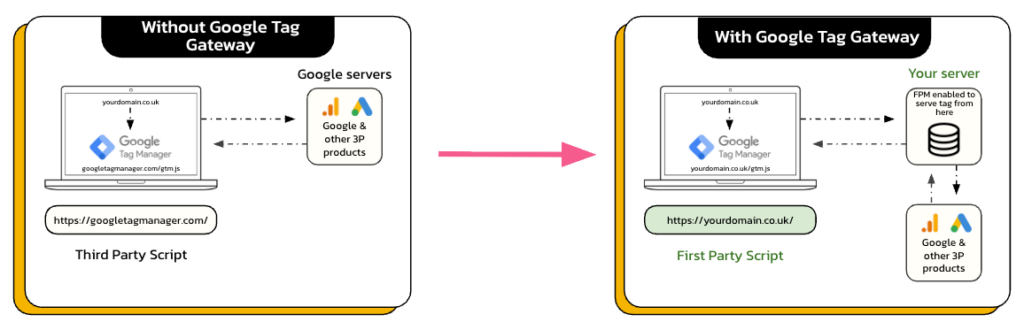
3. The Strategic Advantage: Why GTG Matters
3.1. Driving Demand-Led Growth
Demand-led growth ensures advertising spend aligns with market demand to maximise ROI. In a world of signal loss, “demand-led” is only possible if you can “see” the demand. GTG fuels this by:
Bypassing Restrictions: Circumvents tracking blocks by serving tags via your first-party domain.
Fueling AI Optimisation: High-quality signals are fed into AI bidding systems (like tROAS), improving conversion modeling.
Capturing “Invisible” Demand: Unlocks a “multiplier effect” to identify demand previously hidden by signal loss.
3.2. Increased Measured Conversions
By serving tags from your own domain, GTG provides:
- A higher percentage of captured conversion events.
- More accurate reporting and optimisation signals.
GTG also benefits non-Google tags (e.g., Adobe, Meta) if implemented via a GTM container. If GTG is used for a GTM container, all tags within that container see the benefit, increasing the overall value.
3.3. Improved Conversion Modeling and Data Quality
GTG unblocks tags and captures accurate raw data, offsetting the impact of gCLID loss. This results in a richer data set for more precise conversion modeling and informed optimization decisions. GTG also enhances modeling for existing features like Consent Mode; better data collection directly translates to more precise performance insights.
3.4. Longer Lifespan for Cookies
GTG allows advertisers to leverage server-managed cookies for a significantly longer duration. For example, if a customer returns seven days later, the server-managed cookie can remain active to correctly identify them as a returning user.
3.5. Beyond Measurement: Security and Site Speed
Increased Security: Fewer external scripts reduce potential entry points for malicious actors.
4. Proven ROI: Case Studies
Home Improvement Retailer
The Retailer prioritised a “Data Strength” roadmap with Brainlabs to overcome lead volume struggles caused by signal loss.
Approach: Implemented a “one-click” Cloudflare integration for GTG alongside Consent Mode and Enhanced Conversions.
Results:
- +15% conversion uplift from GTG alone.
- +27% total conversion recovery with the full Data Strength suite.
Leading Insurance Provider
The Insurance Provider faced critical “blind spots” in conversion data due to cookie restrictions.
Approach: Upgraded to server-side infrastructure via GTG and utilised Enhanced Conversions (EC).
Results:
- +20.5% Uplift in Conversions: Confirmed through causal impact analysis.
- -18.7% CPA Reduction: Improved signals allowed Smart Bidding to optimise more effectively.
- 8.7K Reattributed Conversions: Successfully recovered thousands of previously untracked events.
- +4.7% Site Speed: General speed benefit
5. Path to Implementation
Advertisers have multiple flexible pathways to implement Google Tag Gateway:
| Implementation Method | Description | Ease of Setup |
| Via Server-Side GTM (sGTM) | Grants granular control over tag deployment from the advertiser’s server.Note: sGTM implementations incur a cloud hosting cost. | Moderate complexity; High flexibility. |
| Via Cloudflare CDN | One-click integration for Cloudflare users. | High simplicity. (Preferred) |
| Via Other CDNs | Manual mapping of gtag or GTM to the chosen CDN. | Moderate complexity. |
Note:
- If using a 3rd party TMS (Tealium/Ensighten), users must use the gTag implementation route.
- A successful implementation often requires access to both Google Tag Manager and the company’s CDN (such as Cloudflare), which might sit with different teams within an advertiser’s business.
- Currently, sGTM only supports GTG for GA gTags and GTM containers. Implementing GTG for standalone AdWords (AW-) or Floodlight (DC-) tags requires the manual route.
- Note that sGTM implementations incur an additional cost (typically <$1k/month), while Cloudflare does not.
6. Conclusion: The Future is First-Party
As privacy regulations harden in 2026, the transition to first-party data ownership is no longer optional—it is the baseline for durable measurement. By following the example of industry leaders such as a leading insurance provider and a major home improvement retailer, brands can move from defending against data loss to driving aggressive, demand-led growth.
Wondering how much conversion data you’re currently losing? Contact BrainLabs Data Services team for a Measurement Audit today.
*Individual results may vary. Source: Google Internal Data, Global, Finance, July – Dec 2024 vs Jan – June 2025