


The research moment has moved. People who used to find your brand through a search box are now finding it through conversation, and ChatGPT is where most of those conversations are happening. A few months ago, almost every client conversation started ending the same way: “should we be investing in ChatGPT ads?” My answer was consistently the same: the format is interesting, but let’s wait until we know how to talk to users through this medium. We started testing so we’d have something concrete to bring back to them — and here’s what we found.
The question about advertising in ChatGPT is no longer whether brands should be there. It is what the format actually does once you run it. We have been testing it with clients, and the results are specific enough to share.
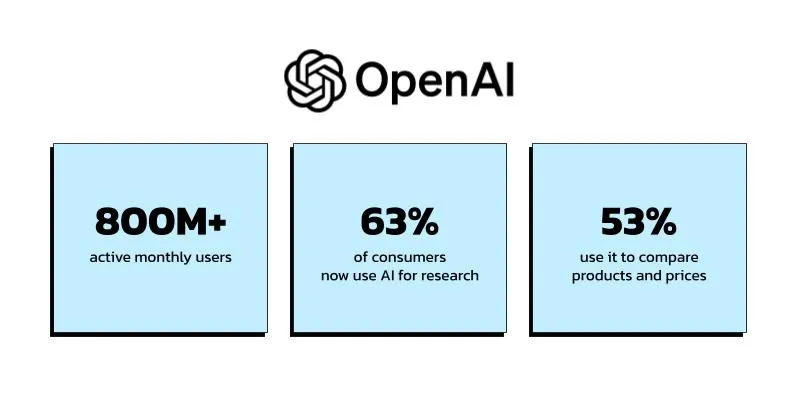
The prize is large enough to justify the testing. ChatGPT is seeing more than 800 million active monthly users, roughly a tenth of the planet, and processes around two billion prompts every day. About 70 percent of all AI assistant traffic currently starts in ChatGPT. Of the people using it, 63 percent say they use AI for research and discovery, and 53 percent use it to compare products and prices. Consideration is moving up the funnel, into a space where brands had no way to show up until recently.
The unit is simple, the targeting is blunt
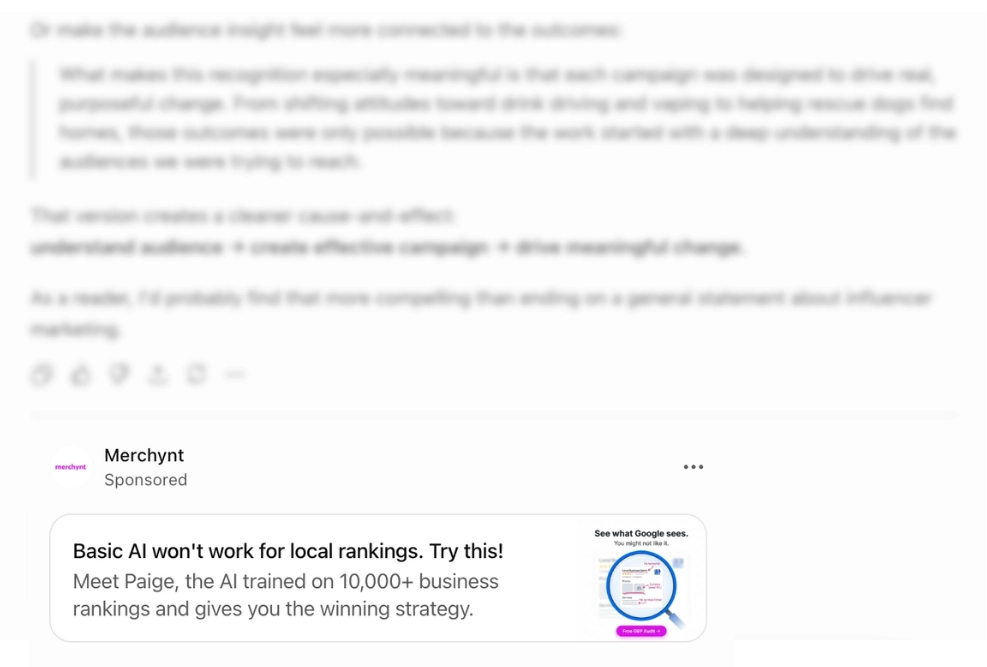
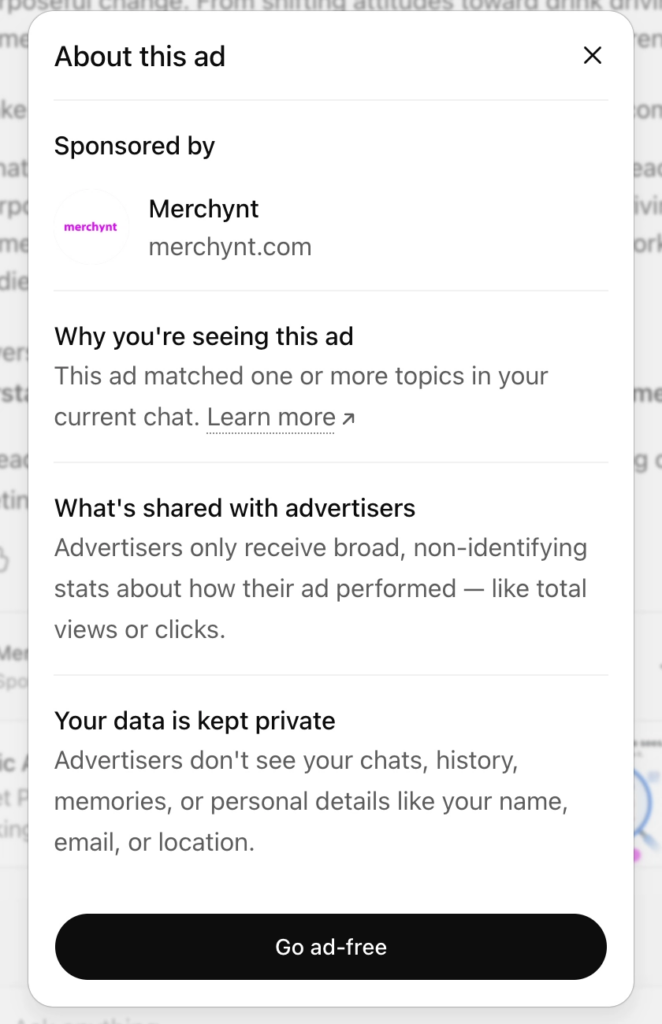
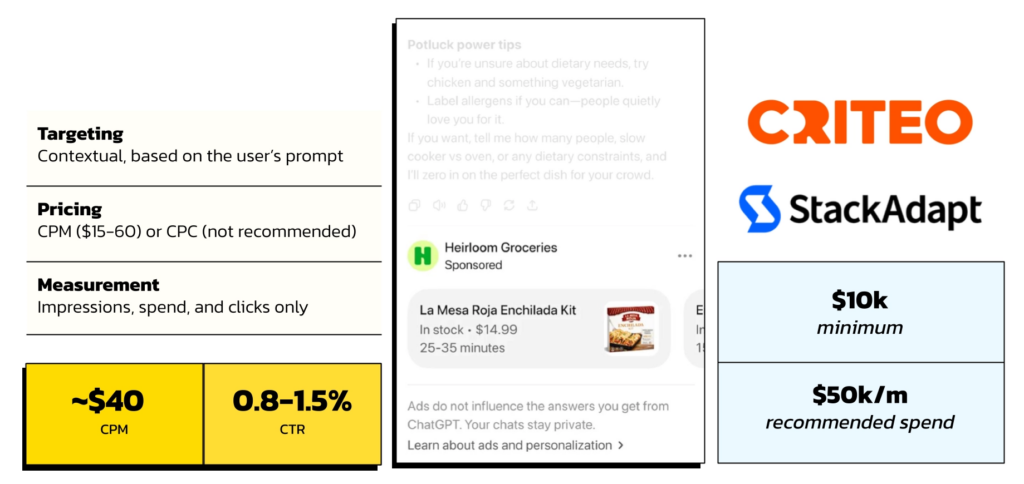
The ad appears below the ChatGPT response in a box labeled “Sponsored”: a single 1×1 image, a headline, a description, and a click through to the brand’s site. The targeting is blunter than most buyers expect. It is contextual only, keyed to the user’s prompt rather than to what the model says back. There is no audience targeting, no demographic overlay, and very little geographic control. Relevancy to the prompt is the only thing that decides whether you serve.
Niche, prompt-aligned creative wins on price
Pricing is where the testing changed how we think about the channel. OpenAI runs an opaque relevancy model and a proto-auction, which in practice creates two prices. Bid on a niche prompt with no competition and you pay around a $15 CPM. Compete for a prompt and win, and you pay up to $60. Across brands, CPMs are averaging between $25 and $35 depending on how niche the messaging is, and our own testing has landed closer to $40.
The lesson is that the channel rewards precision. The more tightly your creative maps to the prompt, the better your cost efficiency. CPC is not worth it. The methodology is too opaque to trust, and we have seen better cost per click by bidding on CPM and letting the clicks come.
Measurement is the real constraint
Today you get impressions and clicks, and little else. There is no direct conversion optimization yet, so you cannot tell the platform to chase outcomes. What you can do is measure the knock-on effects of the clicks and answer the question that matters: do click-throughs from ChatGPT show higher intent than native, display, video, social, or search, judged on what people do once they reach the site? Pixel and conversion data can be shared with partners to help.
The early read on quality is encouraging. CTRs are coming in comparable to native ads, a strong signal for a format this young. The practical takeaway is to build the evaluation framework first. Decide how you will compare ChatGPT intent against site-based interactions from your other channels before you spend a dollar.
Three ways in, and what each costs
There are three routes. Criteo is commerce-focused and can take a product feed, which makes it a strong fit for CPG and retail clients because you can stand up thousands of ads at once. It recommends $50,000 to $100,000 a month. StackAdapt recommends around $50,000 a month and adds some incentives and geo-targeting options. You can also go direct to OpenAI, though that carries a minimum of roughly $250,000 a month.
Which route fits depends on what you are trying to drive. There is little data so far on what the format is best suited for, but it reaches people in a moment of high consideration. So the questions to settle up front are how you want to lead those people to your site and how you will measure the knock-on effect. Your answers should set the budget, not the other way around.
Bottom line
The format is young, the targeting is blunt, and the measurement is thin. None of that has stopped it working in testing, and consideration is still moving into the chat whether or not brands are ready for it. The question now is not whether to pay attention but how much to put behind a test while the rules are still being written.
What comes next is fairly predictable if you’ve watched programmatic develop. Audience targeting will arrive; OpenAI has significant data about its users and leaving it untapped doesn’t make business sense. Conversion optimization will follow. CPMs will rise as more brands show up. The auction will become more transparent. And at some point, the format will look a lot more like the channels you already run.
The brands testing now will have a head start when the format matures. That gap closes fast once CPMs climb and competition arrives.