
Google AI is only as good as the data you feed it. That is not a metaphor. Smart Bidding, Performance Max, Demand Gen, all of it runs on conversion signals. When those signals are incomplete, blocked, or absent, the AI optimises towards the wrong things, or towards nothing at all.
Data Strength is Google’s umbrella framework for the first-party measurement products that recover lost signals, connect online and offline data, and give Google’s AI the complete conversion picture it needs to drive growth. Advertisers who build strong data foundations see 10 to 20% more observed conversions. Those who do not are quietly handing the advantage to their competitors.
This guide explains what Data Strength is, why it matters right now, and how to build it. It draws on Google’s published research and on our own experience implementing these products with clients, including a home improvement retailer where a structured Data Strength programme has driven the account to recover 27% lost conversions.
1. The measurement crisis already underway
Most advertisers do not realise how much conversion data they are already losing. The degradation has been gradual, which is precisely why it is easy to miss.
Safari and Firefox have already restricted third-party cookies. Together, they account for 21% of global traffic. That slice of your audience is being measured less accurately today than it was three years ago, and the situation will not improve. Apple’s App Tracking Transparency framework launched with considerable fanfare, and the actual opt-in rate was sobering: between 15 and 25% of users. That means the vast majority of Apple device users are effectively invisible to standard in-app tracking.
Add ad blockers to the picture. Tag blockers strip conversion signals from a meaningful share of every campaign’s performance. The Google Tag loads from a third-party domain by default, which is exactly the kind of request browser privacy tools are designed to intercept.
The consequence is not just inaccurate reporting. Smart Bidding learns from conversion data. When that data is incomplete, the algorithm cannot identify which clicks, audiences, or placements are actually driving results. It bids in the dark. Campaigns that should be your highest performers start to drift, and the budget allocated to AI-powered tools quietly underperforms what it should be capable of.
The gap between businesses that have built durable measurement foundations and those that have not is widening. Every month of delay is a month of compounding signal loss feeding your AI less than it needs.
2. What Data Strength actually is
If you have attended a Google agency session in the past twelve months, you have probably heard the term. You may also have noticed it comes packaged with several acronyms: GTG, EC4W, EC4L, CM. It is a lot to hold in your head.
Data Strength is Google’s way of bringing these products together under one clear framework.
Think of it as fuel. Google AI is the engine. Smart Bidding, Performance Max, and audience targeting all run on conversion signals. The stronger those signals, the better the engine performs. The weaker they are, the more performance you leave on the table.
What makes Data Strength different from earlier iterations of first-party data messaging is the emphasis on comprehensiveness. One product is not enough. The framework is about connecting all your data sources, online and offline, into a single coherent input that gives Google’s AI the most complete view of your customer journey possible.
There is also a competitive dimension worth naming directly. Google AI will optimise for whoever gives it the best data. If your competitors have stronger measurement foundations than you do, their campaigns learn faster, bid more efficiently, and pull ahead over time. Your data strength is your competitive moat. Other advertisers cannot access it, and you cannot access theirs.
3. The five building blocks
3.1. Google Tag and Google Tag Gateway
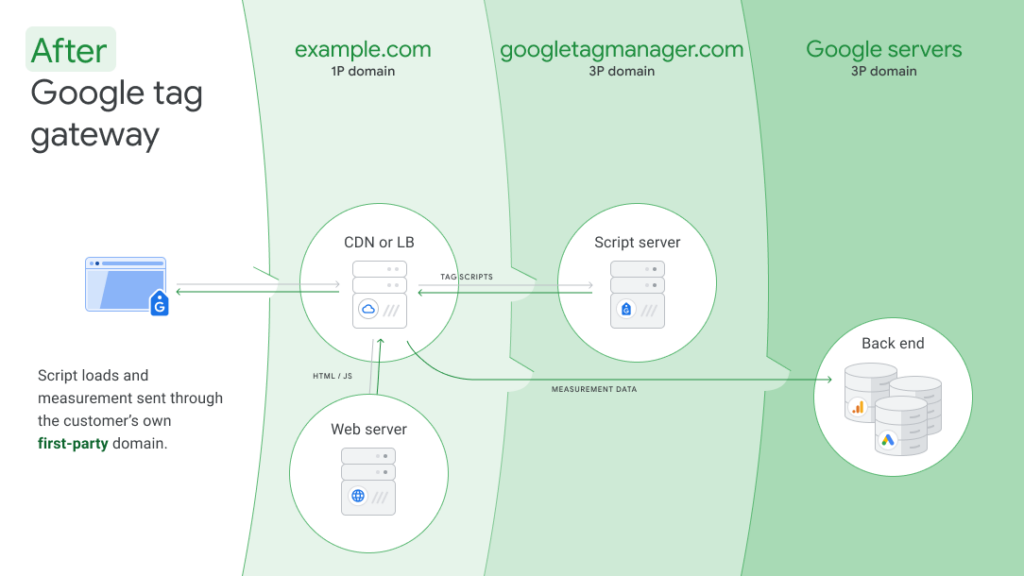
- The Google Tag is the foundation. Every conversion measurement setup starts here. But the Tag alone has a structural problem: it loads from a third-party domain (googletagmanager.com), which ad blockers and browser privacy settings are increasingly treating with suspicion, or blocking outright.
- Google Tag Gateway (GTG) fixes this. Instead of serving the tag script from Google’s domain, GTG serves it directly from your own domain. To the browser, it looks like a first-party request. Ad blockers and Safari’s tracking protection let it through. The tag loads, the conversion fires, the signal reaches Google’s AI.
Advertisers who implement GTG see an average uplift of 14% in observed conversions, with a multiplier effect across every other Google Tag feature that depends on accurate tagging. The whole measurement ecosystem becomes more reliable.
Implementation varies. Clients using Cloudflare as their CDN can enable GTG in fewer than five steps, with no code changes and no re-tagging required. For other CDN providers, server-side GTM, and CMS platforms, the process is more involved but well-documented. We cover the implementation paths in Section 6.
3.2. Enhanced Conversions for Web (ECW)
Once the tag loads, Enhanced Conversions for Web handles the next gap: what happens when a conversion fires but a cookie is not present to identify the user.
ECW works by capturing consented first-party data at the point of conversion, typically a hashed email address, and sending it alongside the standard conversion event. When a cookie-based match fails, Google uses this hashed identifier to attribute the conversion to the right campaign. The mechanism is privacy-safe by design. The data is hashed in the browser before it ever leaves the customer’s system, and Google only ever sees an encrypted identifier, never the raw personal information.
The performance numbers are significant. ECW drives an 8.5% uplift in observed Search conversions and 15% on YouTube. YouTube has historically been the harder channel to attribute, and ECW goes a meaningful way towards closing that gap.
3.3. Enhanced Conversions for Leads (ECL)
ECW handles online conversions. ECL handles the offline half of the customer journey, which for lead generation businesses is often where the real commercial value sits.
The challenge for lead gen advertisers is familiar. Google Ads sees the form submission. What it does not see is everything that happens next: the qualification call, the sales conversation, the closed deal. Standard Offline Conversion Import (OCI) lets you upload that data, but it has real limitations. It is click-based only, does not work across devices, and depends entirely on the GCLID, an identifier that will stop working after Link Decoration Deprecation.
ECL takes a hybrid approach. It captures hashed PII at the point of the lead form submission, alongside the GCLID. When you upload the offline conversion later, Google matches it using multiple identifiers rather than one. More matches. More attributed conversions. Better bidding data.
The performance lift over Standard OCI is 10% on Search and 22% on YouTube. For businesses where the average lead takes weeks or months to close, that is not a marginal improvement. It is a fundamentally different picture of what is actually driving revenue.
3.4. Customer Match
Customer Match is where the measurement layer shifts into audience activation. Upload your consented first-party customer data; hashed email addresses, phone numbers, or physical addresses and Google matches it against signed-in users across Search, Shopping, YouTube, Gmail, and Display. You can reach those people directly, suppress them from prospecting campaigns, or use them as the seed for a lookalike audience of people who share the same characteristics as your best customers.
3.5. Data Manager
Data Manager is where the individual components of Data Strength come together as a system. It is Google’s centralised hub for connecting all your data sources, website, app, physical store, CRM, into a single place, so Google AI has the most complete picture of your customer possible. Advertisers who connect offline and app data through Data Manager see a 26% average increase in incremental ROAS.
The 2026 update makes it universal: Data Manager is now accessible directly within Google Ads, Search Ads 360, and Campaign Manager 360, with Google Analytics to follow. New integrations with platforms like Mailchimp, Klaviyo, and TripleWhale mean more data sources can feed in with less friction. For agencies managing multiple clients, the map view traces each client’s data journey from connection to activation, making it straightforward to see exactly where signals are strong and where gaps still exist.
4. Performance Case
Google’s research on these products is consistent in its direction. More complete data means better AI performance. Better AI performance means more conversions from the same budget.
| Product | Performance uplift |
|---|---|
| Google Tag Gateway | +14% observed conversions |
| Enhanced Conversions for Web | +8.5% Search conversions | +15% YouTube conversions |
| Enhanced Conversions for Leads (vs Standard OCI) | +10% Search conversions | +22% YouTube conversions |
These are median uplifts from Google’s internal data. Individual results vary by account, sector, and starting measurement state. What is consistent is the pattern: every layer of Data Strength adds signal, and additional signal compounds.
The competitive framing matters too. Google AI optimises for whoever gives it the best data. It is not neutral. If a competitor in your client’s category has fully implemented Data Strength and you have not, their campaigns learn faster from every conversion cycle. The gap widens silently, in the background, until it becomes visible in share of impression or market position.
Building a strong measurement foundation is not a nice-to-have for AI-powered advertising. It is the prerequisite.
5. Proven ROI: Case Studies
The Home Improvement Retailer prioritised a “Data Strength” roadmap with Brainlabs to overcome lead volume struggles caused by signal loss.
Approach:
Implemented a “one-click” Cloudflare integration for GTG alongside Consent Mode and Enhanced Conversions.
Results:
+15% conversion uplift from GTG alone.
+27% total conversion recovery with the full Data Strength suite.
6. Conclusion: The Future is First-Party
The conversation about AI in advertising tends to focus on the model: which campaign type, which bidding strategy, which creative format. That focus is understandable. But the model is only half of the equation.
The other half is data. And right now, for most advertisers, that data is incomplete. Signals are being blocked, conversions are going unattributed, and the AI driving campaigns is working with a partial picture. The shortfall is not visible in dashboards because the missing data, by definition, does not show up. That is what makes it so easy to leave unaddressed.
Data Strength is how you fix it. Not in a single sprint, and not with a single product. It is a measurement foundation built across multiple components over time, with each layer recovering more of the signal your AI needs to learn, bid, and grow. The businesses that build it now will have a compounding advantage over those that do not.
Wondering how much conversion data you’re currently losing? Contact Brainlabs Data Services team for a Measurement Audit today.
*Individual results may vary. Source: Google Internal Data, Global, Finance, July – Dec 2024 vs Jan – June 2025
Performance data sourced from Google Internal Data, Global, 2024-2025. Data Strength adoption scores reflect the Brainlabs Digital portfolio as of May 2026. All uplifts are median figures; individual results vary by account, vertical, and existing measurement implementation. Google Tag Gateway uplift figure: Google Data, Global, Performance, January-June 2025. Enhanced Conversions for Leads uplift vs Standard OCI: Google Internal Data, Search campaign types, May 2024.