

Every month, I find myself in a meeting – either internal, with a client or a prospect – where a senior leader asks me a version of the same sharp question. They might be phrased differently at times, but they all point back to a central challenge: “what is the role or purpose of SEO now and why should I pay an agency to do it?”
These aren’t bad questions. They’re the right questions. Ones that I think the best SEO leaders and teams ask themselves constantly, if they want to keep growing and innovating. The problem is when we give vague, hedging answers to ourselves and others, or worse, answers that treat the C-suite like they can’t handle complexity.
Some of the questions below come directly from surveys and industry research. Some are ones I’ve been asked in rooms. All of them deserve a straight answer, backed by what the data actually says. Or what I think about them as an SEO of 10 years who never stops thinking about how to do things better!

Q1. “Is SEO dead?”
No. But the version of it that some teams were running five years ago is dead, and that’s a meaningful distinction.
Here’s what the data actually shows. Across the top 40,000 websites in the US, organic traffic from Google was down about 2.5% in 2025 compared to the year before. That’s a modest decline, not a collapse. Yes, some site types (e.g. publishers) are reporting much larger drops, but those tend to be sites that were heavily dependent on informational queries that AI Overviews now answer directly. The picture varies enormously by sector and intent.
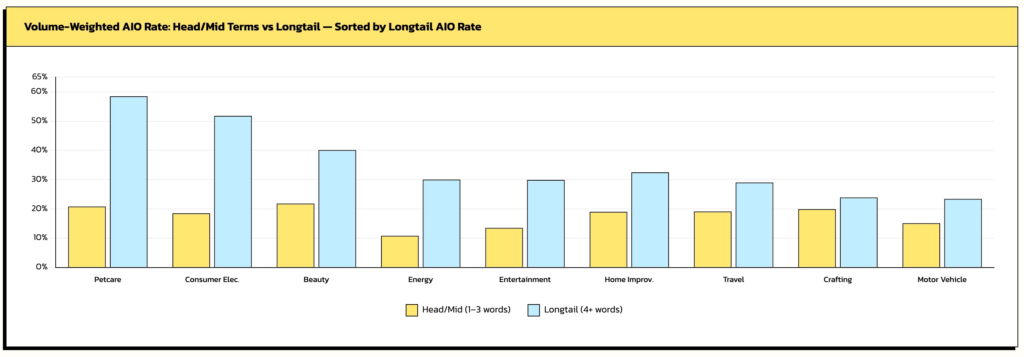
At the same time, reported Google searches/queries are going in the opposite direction. But it’s the type of searches that are increasing which is important – longer tail, conversational queries. This makes perfect sense given people becoming accustomed to searching with more natural language given both AI search usage and Google heavily promoting AI mode/Gemini.
This only exacerbates the zero-click challenge: we have more longtail searches, which generally trigger a much higher rate of AIO or AI mode answers (see chart below), which in turn tend to result in lower traffic to the site.
If people are searching more (and using more platforms to do it), the business of SEO is more alive, and important, than ever.
The more useful framing isn’t “is SEO dead” but “is SEO working for our specific business, in the way we’re currently doing it.” Those are very different questions. Organic search still accounts for more website traffic than paid search across most industries. When done correctly it can deliver a significantly better return on investment than paid media over a meaningful time horizon; or – even better – be part of more cost-efficient holistic search activation. The channel isn’t broken; some approaches to the channel are.
What has changed is the nature of visibility. Ranking in position one for a query that now has an AI Overview answering it directly is worth less than it used to be. But being the brand that gets cited inside that AI Overview? That can be worth more. Brands cited in AI-generated answers see 35% more organic clicks and 91% more paid clicks than those that don’t appear. That’s not dead. That’s a different game, and a new battleground, and teams who’ve understood that shift early are doing well.
The really interesting question is: how many of your customers are really “migrating” to AI search platforms, and how much is that compensating for the loss of organic traffic from Google? And can you predict what things might look like in 12-24 months’ time? Look out for my in-depth analysis on all this coming soon!
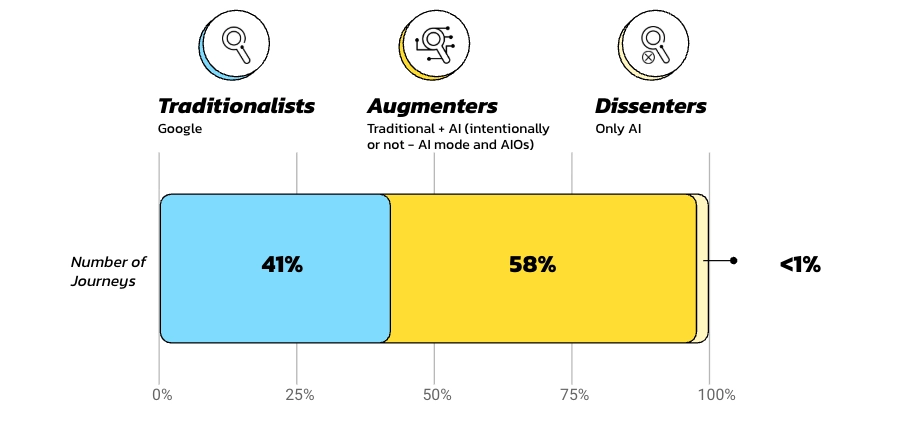
To cap this question off, if you’re an exec or anyone who’s still on the fence about the importance of (AI) SEO, consider this: most data under-estimates the number of users exposed to AI in search. Around 30% of UK consumers already use AI for product research (based on the average across all publicly available studies). We can safely infer that the remaining 70% of searchers use Google or Amazon, with only a small percentage using AI exclusively. Then if 40% of all Google SERPs now have an AI Overview, we estimate somewhere in the region of 60% of searchers are exposed to AI results, whether they asked for them or not. And if the trends hold, we’re looking at 80% a year from now.
Q2. “Should we be doing AEO and GEO instead? And what even are those?”
Yes, you should care about these. No, my opinion is you don’t need new teams for them.
I looked back at all the new business briefs we received in the past 3 years (since roughly the advent of AI search, following ChatGPT’s launch). And 12 months ago, less than 50% of RFPs explicitly named AI search as a service required; now every single SEO RFP includes these as a core requirement OR we get enquiries about exclusive AI SEO/GEO/AEO retainers or projects. For every existing client we are delivering AI Search strategies or testing plans.
AEO (Answer Engine Optimisation) and GEO (Generative Engine Optimisation) are newer terms for the practice of optimising your content to appear in AI-generated answers — whether that’s Google AI Overviews, ChatGPT, Perplexity, or similar. Conductor surveyed over 250 enterprise CMOs and digital leaders at the start of 2026 and found that 94% of enterprises planned to increase AEO/GEO investment that year, and those who’d already invested were reporting measurable business impact.
2× Visitors arriving from LLM-generated responses convert at roughly twice the rate of standard organic visitors, in a third of the number of sessions. A smaller but disproportionately high-quality audience. Conductor, 2026
That’s good news for SEO teams. And the truth is SEO and GEO are similar right now, but they’re diverging. And the rate of divergence is faster than most teams realise.
The good news first. For now, most traditional SEO work still benefits AI visibility too. Getting into Google’s top 10–20 results helps, because AI Overviews pull heavily from those positions. And traditional Google SERPs are still where the majority of consumers are researching purchases. Clear authoritative content, strong structured data, genuine depth – all of this serves both. The teams creating problems for themselves are those treating SEO and GEO as completely separate workstreams with separate budgets and separate strategies, before the split actually requires it.
But the divergence can’t be ignored and is accelerating. There’s evidence that AI Overviews’ overlap with Google’s top 10 results has halved in a single year — from 76% in 2025 to 38% now based on data from Ahrefs. Gemini, which is a Google product, only overlaps 15% with Google’s own top 10 rankings. Perplexity’s overlap with the Google top 20 is just 10%. These platforms are not simply reading off the same ranking signals Google uses; they’re building their own models of what constitutes a good answer, and those models are diverging over time.
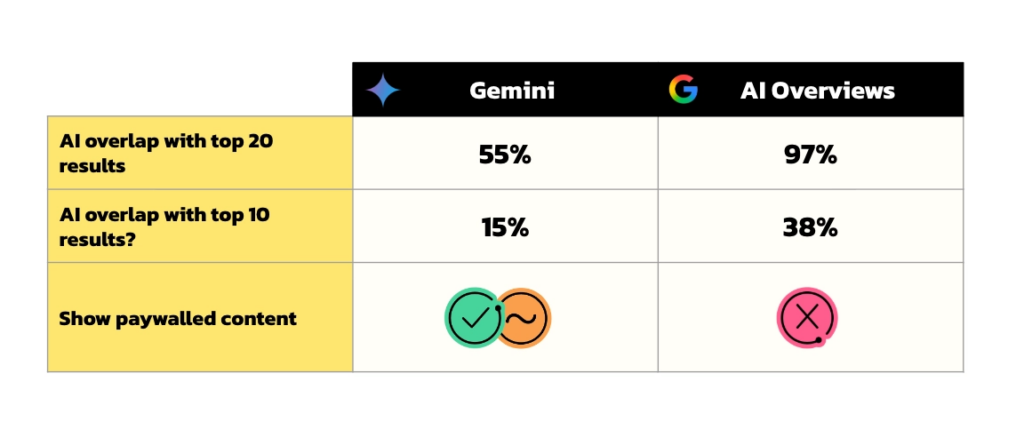
The practical implication: what works for Google rankings and what works for LLM citation are becoming different problems. Not entirely separate yet, but heading that way. The brands and teams that will be well-positioned in two years are the ones building the capability to understand and test both, rather than assuming one strategy covers both channels indefinitely. I think we’re roughly in the middle of that transition now, which is exactly why this question is worth taking seriously rather than waving away.
Q3. “Can we just use AI to create all our content now?”
Given the advances in genAI copy, this is something we’re hearing more and more. Earlier this year, I was in a new business process where the CMO was questioning why we can’t just programmatically generate 1000s of pages across their portfolio of brands, all with AI content that we’ve tweaked enough to sound like a human wrote in their brand ToV. And by doing so, effectively dominate SERPs globally.
Some SEOs may roll their eyes here. But it’s a fair question. You certainly can do this. It’s not a good idea, at least not without understanding what the actual bottleneck is (because it certainly isn’t copy generation!).
The confusion comes from a misreading of what Google actually penalises. Google’s official position is that AI-generated content isn’t penalised simply because of its origin. What gets penalised is content that is shallow, generic, mass-published, and adds no value. And, the problem is that most AI-generated content, when used without meaningful human input, is exactly that. It’s not AI that breaks it. It’s the lack of substance.
17% of top 20 search results are now AI-generated — but those are the outliers who used AI to produce genuinely useful content, not to churn out thin articles at scale. Rankability, 2025
There’s also a second problem, which is the audience. Your readers can tell. Not because they run the content through a detector, but because generic AI content reads like generic AI content: technically correct, well-structured, and completely forgettable. It doesn’t contain anything proprietary. It doesn’t have a point of view. It doesn’t tell the reader something they couldn’t have found on the first three pages of a Google search.
Brainlabs ran experiments with AI content on ourselves before recommending it to clients. Our Global CMO Liz Yoselowitz built an AI visibility content programme using AirOps, with one Content Engineer running the entire function. In three months, AI Share of Voice grew 35% and Mention Rate grew 42%. The reason it worked wasn’t anything to do with volume — it was that every piece of content started from real client conversations, real pain points surfaced in pitches and discovery calls, with channel experts reviewing and shaping everything before it was published. AI handled production. Humans handled the substance. That combination is the point.
Our very own Chief Data Strategy Officer, Will Akhurst, makes a related argument in his piece on infinite creative and ad performance. Generative AI has essentially solved the production bottleneck for ad creative — you can now make anything, in any variation, at trivial cost. But that just shifts the hard problem. In a world of infinite creative options, the constraint becomes selection: knowing which creative to test, and why. The same is true for content. AI removes the production barrier. It doesn’t tell you what’s worth saying.
I think the right way to use AI in content production is to treat it like a very fast first drafter that needs substantial human expertise layered on top: real data, real insight, real opinion, real examples from the business. That produces good content efficiently. Using AI to replace all of that just produces a lot of words.
That said, I believe nothing is off limits when testing SEO, even techniques that we might think would have a negative impact based on Google’s guidelines. Write all your copy with AI and measure the impact properly to see, but know that it comes with severe risk warnings!
Q4. “Why can’t I see the ROI from SEO?”
Usually, because it’s being measured wrong.
SEO ROI is genuinely harder to attribute than paid search ROI. With paid, you can draw a direct line from a click to a conversion to a cost. With SEO, there are longer lag times, multi-touch journeys, and a meaningful chunk of value that shows up in channels other than direct organic traffic — things like brand search volume, lower CPCs on branded terms, and assisted conversions. Most standard attribution models don’t capture that well.
The 59% of CMOs who say their budgets are insufficient to execute their strategy, per the Gartner 2025 CMO Spend Survey, are operating in an environment where everything needs to be justified fast. That creates pressure to make SEO look like paid, which it isn’t, and shouldn’t be. SEO compounds over time in a way paid doesn’t. Stop the paid spend and traffic stops the same day. Stop SEO investment and you’re living off a slowly depreciating asset: content erodes, competitors catch up, technical issues accumulate.
There’s a version of this that’s a reporting problem, not a performance problem. If your SEO team or agency is reporting on rankings and traffic, and your finance team is asking about revenue and pipeline, those conversations are never going to connect. The fix is to build reporting that ties organic performance to business outcomes: what’s the assisted revenue from organic? What’s the cost per acquisition compared to paid? What share of qualified pipeline touched organic search at some point in the journey? Those numbers tell a different story than a traffic chart.
Certainly, the rise of AI search has further complicated the measurement and attribution challenge for organic search. Firstly, because discovery, consideration, and conversion may end up happening in seconds or minutes all within the same platform (e.g. Gemini or ChatGPT), it poses serious questions around what attribution should look like in a “collapsed” funnel. And secondly, we don’t have access to data on that journey/conversation, those micro-actions if you like. Yes, we can now see the first query/question and impression data in Google Search Console, but between that and a click to a site or (agentic) purchase, we have what some people are calling an “AI dark funnel”.
In some ways, nothing new here for SEO. In the sense that as a channel we have always had only partial access to data for attribution: Google has never given us complete keyword-level conversion data for example. So we have relied on correlation analysis, incrementality testing, and other testing methods to prove impact and value of our work. The new world just requires a change in our approach: the variation in AI responses means you need to track prompts way more than you probably are (or were for Google keyword rankings); zero-click searches/no interaction in AI answers mean we need to find ways to connect impressions with on-site actions, and the experiments might be brand new, such as holdout tests with AI crawlers.
Q5. “Why does SEO take so long?”
Because you’re building an asset, not renting one.
The lag between SEO investment and SEO results is real. For a site with limited authority, meaningful improvements in competitive categories typically take six to twelve months to show up in revenue. That’s frustrating, especially when a paid campaign can be live in a tiny fraction of the time.
But the framing of “slow” treats SEO like a short-term tactic, and it isn’t. A well-built piece of content that earns links and ranks well can drive traffic for five years. The paid equivalent of that traffic costs money every single day it runs. The reason SEO takes time is the same reason it has a better long-term return: it’s building something durable rather than buying something temporary.
There are also things within an SEO programme that move quickly. Technical fixes can have near-immediate effects. Quick wins on existing content – pages that already rank but could rank higher – can often deliver results in weeks. A well-prioritised programme isn’t one where everything is slow; it’s one where the quick wins fund credibility for the longer-term bets.
The honest answer to “why does it take so long” is: because you probably didn’t start early enough or your roadmap wasn’t properly prioritised. That’s not a criticism; almost everyone is in that position. Or they’ve been dealt a bad hand by Google updates. But the answer isn’t to stop. It’s to start now and adjust expectations about when you’ll see the full effect.
Q6. “Our organic traffic is down. Is that SEO’s fault?”
Maybe. But the most common cause right now isn’t something your SEO team did wrong.
As I mentioned above, AI Overviews — Google’s AI-generated summaries at the top of search results — appeared on roughly 30% of queries in 2025 and reduced click-through rates significantly for those queries. Some studies put the CTR reduction at around 35%, while others have found drops much closer to 61%. If your traffic is down and your rankings are broadly where they were, that’s almost certainly the culprit. And it’s only exacerbated by a general increase in the kinds of longer tail searches that trigger AIOs.
The distinction matters because the response is different. If traffic is down because of a technical issue, a penalty, or a competitor overtaking you, the fix is SEO work. If traffic is down because Google is now answering more queries directly before users click anywhere, the fix is repositioning: creating content that earns citation inside those AI answers rather than content optimised purely for click-throughs.
One thing worth checking before concluding SEO is broken: are conversions tracking proportionally to the traffic decline? A lot of the traffic that AI Overviews remove was low-intent informational traffic anyway. If revenue from organic hasn’t moved as dramatically as traffic has, that tells you something. The channel may be delivering less volume but roughly the same value. And then if you can blend in AI search traffic and conversions, you may find the picture is not as alarming as it seemed!
Q7. “Why are we investing in SEO when paid search gives instant results?”
Because they’re not substitutes. They’re doing different things.
Admittedly, this is a rarer question these days! As understanding of organic search has become more widespread among the C-suite (and hence, why it’s towards the bottom of my list!)
Paid search gives you visibility when you’re paying for it. The moment the budget runs out or costs rise, the visibility disappears. SEO’s goal is to build an asset: content that ranks, attracts links, and earns trust over time. The investment-to-return timeline is different, but so is the permanence of what you’re building.
Gartner’s 2025 CMO Spend Survey found that paid search takes about 14% of the average digital marketing budget, while SEO takes around 8%. Most sophisticated marketing organisations run both, because they address different stages of the journey differently. Paid search is excellent for capturing high-intent demand at scale, quickly, and with precise targeting. Organic search is better for building brand authority, reaching people earlier in the decision journey, and creating a return that doesn’t require continuous spend to maintain.
The instinct to cut SEO when budgets tighten is understandable but often counterproductive. When brands reduce SEO investment, they don’t just pause the gains: they start eroding existing assets. Content rankings decay. Competitors move up. Technical debt builds. When you’re ready to restart, you’re not picking up where you left off. You’re starting over with a weaker baseline. The compounding cuts both ways.
I think the right answer to “why both” is: because in three years, you’ll be glad you kept building the thing you own rather than only renting visibility from a platform whose prices can go wherever it wants them to go.
What actually makes SEO work
The questions above come up because SEO is still complicated and has only been made more complicated by AI search (take it from someone who’s spent a decade getting his head around it!). And so it is easy to miscalibrate in either direction. Either it gets treated as a quick-win tactic that should show returns in six weeks, or it gets treated as a long-term background function that doesn’t need active attention. Neither works.
The organisations getting the most from SEO right now share a few things in common. They’ve connected SEO performance to actual business outcomes rather than traffic metrics. They’ve shifted their content investment from volume to genuine quality. They’ve started building for AI visibility alongside traditional rankings rather than treating the two as competing priorities. And they’ve maintained consistent investment even when short-term results were hard to read, because they understood what they were building.
None of that is secret knowledge. It’s just harder to execute than it sounds, especially in large organisations where SEO spans content, development, and marketing, and no single team owns all of it.
If any of the questions in this article are ones you’re asking about your own SEO programme, that’s a good sign: it means you’re taking the function seriously! The next step is making sure you’re getting honest, specific answers rather than dashboard updates dressed up as strategy.
Look out for my upcoming article on the New Organic: What SEO looks like when AI answers first.