

Cast your mind back to the old Meta setup. Campaigns broken into a dozen audience segments, each with a handful of creative assets. The algorithm starved for signals. No clear read on which creative was actually serving to which audience, and no reliable way to find out. For campaign managers, it meant living in the dark, pulling levers and hoping something moved.
That world is mostly gone. The algorithm does the audience work now. What matters is what you’re actually showing people, not who you’ve decided to show it to. That sounds like progress, and it is, but it also puts all the pressure on creative in a way most brands still haven’t fully reckoned with.
The ceiling nobody talks about
Most brands, when they find a creative that works, do the sensible thing: they iterate on it. They change the copy. They swap the background color. They trim the hook by two seconds. And for a while, this approach works. Then it stops. The asset that was driving returns starts to plateau, and the incremental changes stop producing incremental gains. This is diminishing returns on creative, and it’s more common than most media teams want to admit.
The problem isn’t iteration. Iteration is good. The problem is when iteration becomes the whole strategy and the team stops discovering genuinely new creative directions. When you’re only squeezing the winner, you have no pipeline behind it. So when it eventually runs dry, you’re starting from scratch.
The new goal is a system that continuously finds new creative winners, while protecting the returns on what’s already working. Here’s how we build it.
Stage one: Reading signals that the platform can’t see
Meta provides a lot of signal data, and it’s useful. But platform data tells you what performed. It doesn’t always tell you why, and it rarely tells you what to try next. For that, you need to go a level deeper into what your audience is actually talking about, where those conversations are happening, and what’s driving them.
That’s where Sentiment Analysis comes in. It’s a tool we built that crawls TikTok, Reddit, and broader web content at scale, analysing not just what people are saying about a category or product, but how they feel about it: whether conversations are positive, neutral, or negative, and crucially, what’s fuelling them. For a spicy noodle brand we work with, it surfaced something no brief had ever captured: a significant volume of content around people making the product with milk instead of hot water. That wasn’t a known use case, but it was clearly resonating with a real audience segment, and it pointed toward an entirely new creative territory, including a creator partnership built specifically around that behaviour.
Trend data adds another layer. Identifying a trend at the moment it starts gaining traction, rather than after it peaks, is the difference between being part of a cultural moment and being a brand that reacted to one. For Adidas, spotting an emerging visual trend early enough to get content live within three days meant over a million views and a 16% engagement rate within 24 hours. That kind of result doesn’t come from great creative alone. It comes from great creative deployed at the right moment.
Stage two: Building with intention
Once you have those signals, the question is how to translate them into a creative strategy that maps to how people actually encounter your brand. The traditional funnel is still a useful planning device, but the consumer journey isn’t linear. People see a conversion ad before they’ve seen a brand ad. They encounter creator content before they’ve ever searched for the product. So the creative at each stage needs to tell a coherent story even when seen completely out of sequence.
The way we approach this with clients is to think in contextual layers rather than sequential stages. High-fidelity brand creative does the work of establishing who you are visually and emotionally. Creator content handles authenticity and trust in the middle of the funnel in a way polished brand advertising simply can’t. Promotional messaging and product catalog ads close the gap for the audience that needs a specific reason to act. Each layer does a distinct job, but the whole thing should read as one brand regardless of entry point.
Working with a global beauty brand, this meant building a journey where the creative ranged from motion-designed brand content produced by our internal team to creator-produced assets, and the goal throughout was the same: if someone saw any single piece in isolation, they’d understand immediately what the brand was about. That coherence is what makes the approach work even when people don’t move through it in any particular order.
Stage three: Testing with structure
More testing isn’t the answer. Smarter testing is. The distinction matters because unstructured testing produces data you can’t act on. If you’re running multiple simultaneous experiments without clear variable isolation, you end up with results that are interesting but inconclusive, and the learning doesn’t carry forward.
Structured testing means knowing what you’re testing before the test begins. It means broad audiences with overlaps suppressed, so each asset gets a clean read without interference from adjacent targeting. One variable at a time, consistently. It’s slower, but it produces findings you can actually build a creative strategy from.
There’s also the question of what you test with. Most teams default to putting creative straight into paid, which is an expensive way to find out whether something works. Organic is a better first environment. If an asset doesn’t connect there, it’s unlikely to outperform in paid. Testing organic first means you’re putting media budget behind things that have already shown some pull rather than hoping they will.
One practical note here: check your influencer contracts before you get attached to a piece of creator content. If paid amplification isn’t written into the agreement, you can’t repurpose a top-performing organic asset without going back to renegotiate. It’s a small administrative issue that becomes a meaningful one when you’re trying to move fast.
Stage four: Scaling without losing speed
Once something proves it works, the bottleneck is almost always speed. The analysis of what worked, the brief to creative, the production, the deployment: traditionally this cycle took days, sometimes longer. The window between “this is working” and “we’re making more of this” was wide enough that momentum was regularly lost before anyone could capitalize on it.
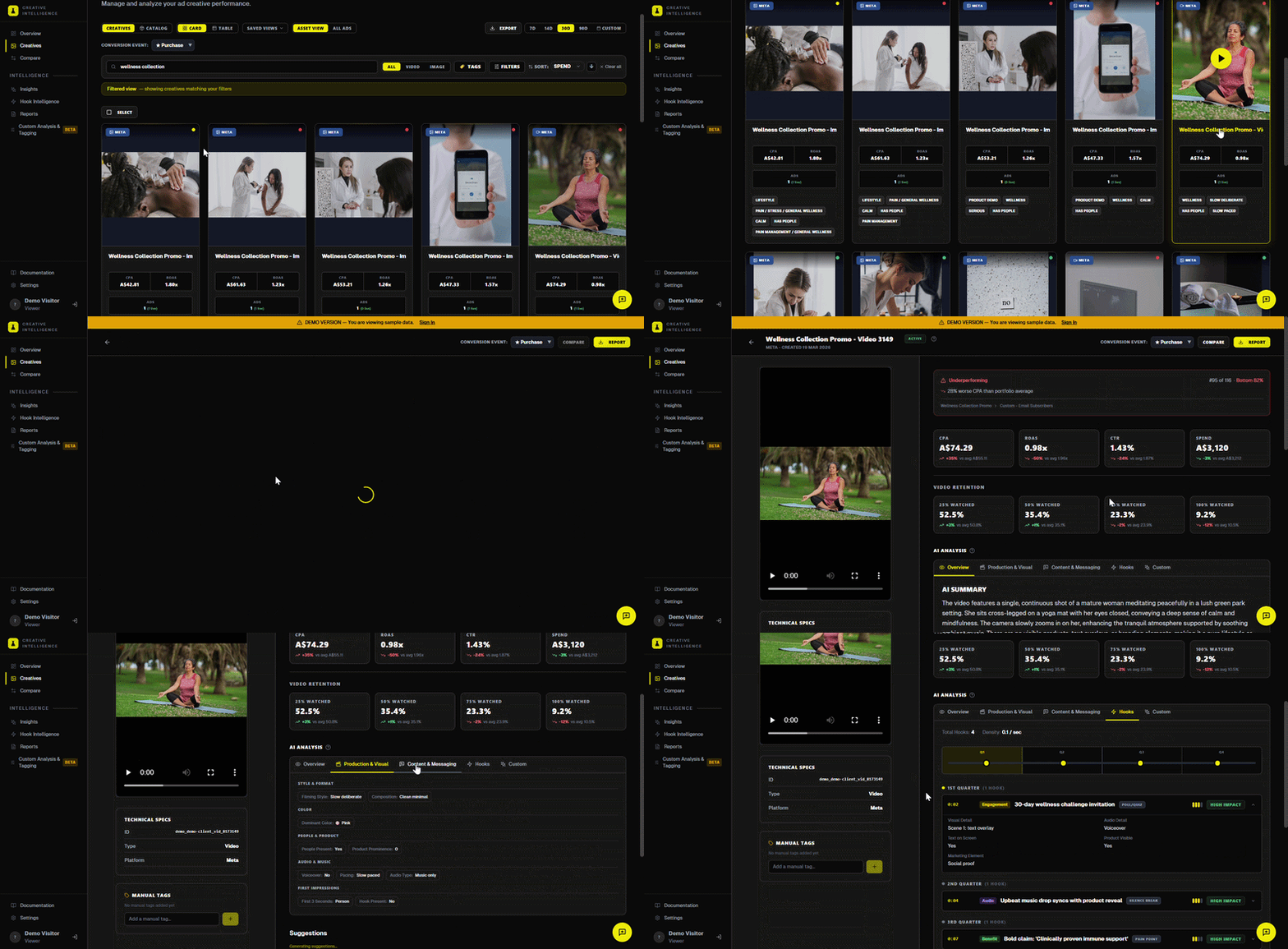
Our Creative Intelligence tool was built to close that gap. Rather than asking a team to manually review performance data and translate it into a brief, the tool does that analysis automatically. You open an ad and instead of a blank page, you have a full breakdown: which hooks drove completion, where viewers dropped off, which visual moments correlated with engagement spikes. It identified, in one case, that a spike at the four-second mark in a video was likely driven by a dog appearing in frame. That level of specificity about what’s working inside the creative itself isn’t something we’ve seen elsewhere, and it means the brief to the creative team is grounded in actual evidence rather than instinct.
The other dimension of scaling is what you do with learnings across time and across clients. Experiments within a single account tell you something. Experiments across hundreds of accounts, anonymized and aggregated, tell you something far more useful. We track all of our experiments in a proprietary system called Hippocampus, which currently holds over 35,000 experiments across our client base. The patterns that surface from that volume are things you’d never find in isolation.
The part that actually holds it together
All of this depends on one thing that no tool can fix: the creative team, the media team, and the data team actually talking to each other. Not occasionally, not in a monthly review, but consistently, treating themselves as a single loop rather than three separate functions delivering handoffs. When these teams are siloed, the system breaks. Creative iterates without knowing what the data is showing. Media optimizes without understanding what the next creative direction is. Data produces insights that never reach the people who need to act on them.
You don’t need sophisticated workflow architecture to fix this. You need the right conversations happening at the right frequency. That’s where most creative systems quietly fail, and it’s also the easiest problem to solve.