

Demand generation is the best way to avoid stagnation, and deliver sustained business growth, but that’s not to say it is straightforward. The battle for attention on social media has never been more fierce. Content feeds are limitless across multiple platforms, offering instant education, entertainment, and inspiration. At the same time, advertising technology has reached new levels of sophistication. AI and automation are accelerating the industry’s evolution, where manual controls and optimisation require a greater depth of understanding and application. As these technologies extend beyond performance campaigns, we’ve been asking: what does this increased system autonomy mean for brand campaigns, where algorithms can have varying intent signals to optimise from?
At Brainlabs, we’ve been leveraging artificial intelligence in advertising whilst many were still skeptical. That commitment to innovation remains steadfast, but we also strive to challenge accepted principles and continually expand our expertise. As we continue to roll out AI-driven campaigns for our clients, our scientific methodologies remain essential to validate and optimise the brand building levers that are still within our control.
With this in mind, we set out to uncover what levers we can pull to truly shift the dial for our clients in this increasingly automated landscape, striving to deliver the most effective campaigns possible. The outcome was a data-backed framework revealing which campaign objectives, creative types, and frequencies deliver the most significant changes in brand metrics, turning Meta’s evolving architecture into a precise map for effective brand building.
The Challenge
Performance marketing is fast and clean, you make a tweak and see the results in days, but brand building is slower, and full of fuzzy signals. Meta has released plenty of brand building playbooks. We could have taken this at face value, but that’s not very Brainlabs… We wanted to validate their rulebooks for ourselves.
The key to finding answers is big data. We ran and applied a large bank of Meta brand lift studies to identify the advertiser inputs that matter; campaign goals, creative type, and frequency, with a goal of understanding how each influences key brand metrics like awareness, consideration, and purchase intent.
Execution
We conducted a comprehensive analysis across 46 Meta brand lift studies, covering 225 UK campaigns across 10 brands. Creatives were categorised into five pillars:
High Fidelity (Hi Fi) Brand – heavily branded and highly produced creative, that you may expect to see in the cinema or on television.
Product Focus – creatives that talk to specific product benefits or features. These rarely contain people, instead heroing the product or range.
Low Fidelity (Lo Fi) Native – creator, influencer, or user generated content (UGC) creative
Promotion – assets that reference a specific promotion or price point.
Catalogue – ads that dynamically leverage the Meta product feed as creative
There are three ways of optimising for brand on Meta, so our analysis included the Reach, Ad Recall, and Thruplays objectives, testing their impact on audience type and brand metric shifts.
To ensure robust findings, we applied a Random Forest regression model to the dataset, allowing us to isolate the influence of objectives and creative types while controlling for other variables.
By combining advanced statistical modelling with category expertise, we turned thousands of campaign data points into actionable rules of engagement for brand building on Meta, rules grounded in evidence.
Our Findings
1. Campaign objectives shape your audience. Social plans are often shaped around KPI deliverables, which can cause us to forget that there are real people behind each impression, who will each be at varying stages in their purchase journey. To change behaviour in a meaningful way, you need to know what your starting point is, so it’s essential that we understand users’ awareness of your brand and product.
We found that Reach campaigns delivered to lower-awareness audiences, with 69% of the control group reporting that they knew the brand vs 82% of the control group for other campaign goals. This clearly suggests the Reach goal to be ideal for new customer acquisition. Ad Recall and Thruplay skewed to audiences already familiar with the brand, often older, with heavier Facebook consumption (73% Facebook delivery vs 65% for other goals).
2. Traffic still matters. Traffic campaigns may have gone out of fashion, their value falling under scrutiny in some circles, but our data shows the ‘View Content’ campaign goal to be a powerful driver of product purchase intent (8.0% lift vs 4.2% average for all campaign goals). This was particularly true when paired with Lo-Fi native creative (9.7% combined lift vs 8% average for View Content). Whilst not a typical ‘brand building’ metric, intent is essential for the transition from demand generation to capture.
Reflecting on findings 1 and 2 – It is important to understand that simply choosing a campaign goal will not guarantee that the user will take the desired action. Instead, selecting a campaign goal will help us to find those likely to take an action, and serve in a way that increases the likelihood of this happening. You still need effective messaging to inspire them to take action. Which leads us nicely onto…
3. Creative is decisive. We saw the largest shifts in brand awareness for Hi-Fi brand and Product creatives (8% and 7.5% lift vs no detectable lift) when delivering to a net new/reach audience.
These results are likely due to the strong visual impact and evidence of brand red threads – distinctive elements that consistently reinforce brand identity – helping users remember the ad and recognise the brand. Cognitive load theory (Sweller, 1988) explains that when cognitive load is high (such as processing information with unclear messaging), consumers may struggle to process the information presented, leading to less effective ads.
Product-focused ads were the strongest drivers of product consideration (3.9% lift vs 2.6% average across all creatives) and brand consideration (6.2% vs 5.2%), however it took an authentic human voice, Lo-Fi native, to shift product purchase intent (6% vs 4% lift average lift for all creatives). Traditionalists would obsess over production value, but these findings show the power of ‘low-fi’ native content (shot on phones, not film sets) to outperform glossy brand campaigns.
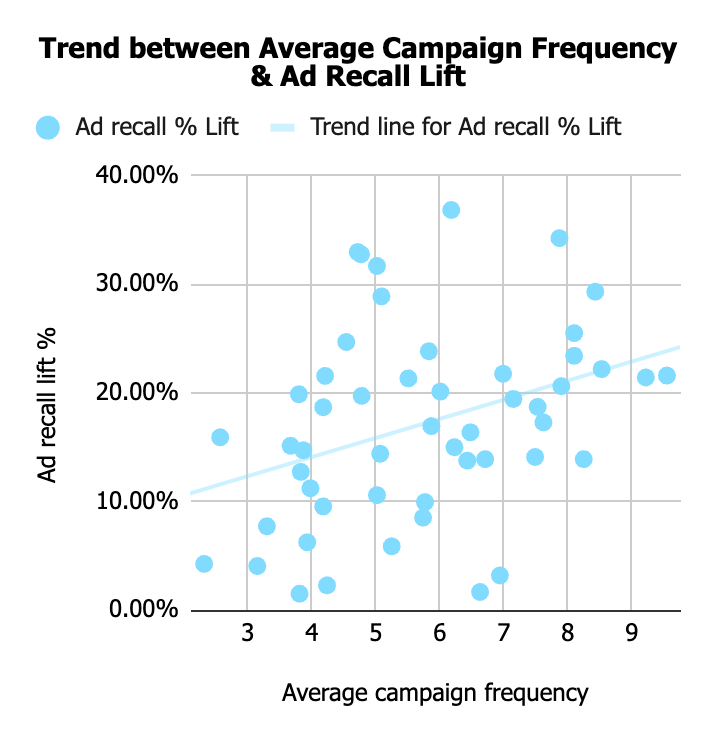
4. Frequency fuels memory. The strongest recall gains came from campaigns delivering two exposures every seven days, validating Meta’s emphasis on “aggregated attention” vs the industry’s focus on one-off “attention spikes.”
The Takeaway
We will continue to build and use AI-powered systems within our social campaigns, but also persist with our scientific approach to test and learn. By understanding which objectives, and creatives drive brand metrics, we can make informed decisions that go beyond the algorithm to influence new customers down the path to conversion, fast.
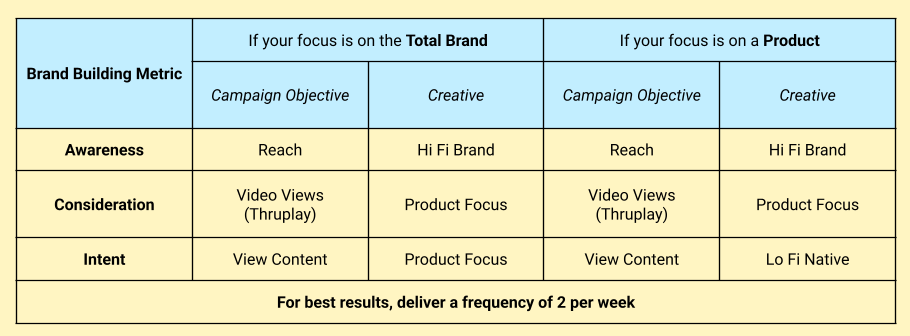
Our findings have been compiled into this cheat sheet below to help you to get the most out of your advertising.