
Spend enough time reading about the future of Search and it’s easy to come away thinking everything is changing. AI Max, conversational search, automated campaign types, generative creative, agentic workflows – there’s no shortage of headlines telling us the old playbook no longer applies.
I’ve spent the last few weeks thinking about all of that noise, and I keep coming back to the same conclusion: the fundamentals haven’t changed. What’s changing is where competitive advantage comes from.
Strip paid search back to first principles and success still comes down to one thing: winning the auction. Google built one of the most profitable businesses in history on a remarkably simple idea: every auction is won by some combination of the bid you submit and the quality of the ad you show. That was true when I started in Search in 2011, and I expect it will still be (should be?!) true long after today’s wave of AI products has evolved into something else.
What AI is changing isn’t the auction itself. It’s how much influence we have over each side of it, and where agencies create the most value for clients.
The Bid: familiar, but harder than it looks
The bidding side hasn’t shifted much thematically. Success still depends on privacy-safe measurement, high-quality first-party data and bidding towards the right business outcomes through value-based bidding. None of those ideas are particularly new.
What has changed is the level of sophistication required to get them right. Measurement has become significantly more complex, regulation has raised the bar for data collection, and Google’s automation only performs as well as the signals it’s given. That means data literacy is no longer a specialist capability that sits alongside Search. It has become a core part of modern Search itself.
There’s another consequence that deserves more attention. As advertisers become better at generating value from every click, Google’s automated bidding systems naturally allow them to compete more aggressively in the auction. Higher value per click doesn’t simply improve efficiency; it increases the amount of inventory a business can realistically afford to win. Better commercial performance compounds into greater market share without someone manually increasing bids.
The ad: where I’ve had to change my mind
If the bidding side has become more technically demanding, the bigger shift is happening on the creative side.
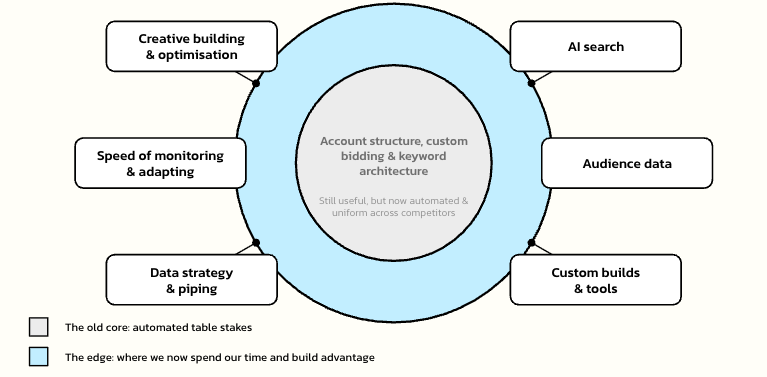
For much of Brainlabs’ history, one of our strongest competitive advantages came from account structure. Whether it was SKAGs, keyword themes or the framework of the day, we believed that better structure created better relevance, and therefore better ads. It was a genuine advantage and one that consistently delivered results for our clients.
More recently, I’ve found myself questioning whether that advantage is as meaningful as it once was.
Some structural principles remain essential. Organising campaigns thoughtfully, maintaining sufficient conversion volume and grouping intent intelligently are still good practice. But when Google can dynamically customise creative in real time, understand intent more effectively than ever and optimise campaigns through products like AI Max, the amount of work that account structure alone is doing is becoming smaller.
That requires a shift in thinking.
For years, agencies invested enormous amounts of effort into building the perfect structure because structure was one of the best ways to influence the quality of the ad. Increasingly, the more powerful lever is the quality of the assets themselves. Google’s own guidance points in this direction: stronger headlines, descriptions, images and messaging give its systems more to work with, producing better outcomes than structure alone ever could.
If that’s true, then the agency opportunity changes as well.
Instead of treating creative production as something that supports campaign management, we should be systemising how we generate better creative in the first place. That’s where much of our investment at Brainlabs has gone. We’ve built tools that analyse competitor messaging across the SERP, identify which creative assets are genuinely driving performance, and automate repeatable campaign processes so our teams can spend less time rebuilding foundations and more time improving what customers actually see.
Viewed through that lens, AI isn’t reducing the value agencies provide. It’s changing where that value sits.
The work that matters now
At Brainlabs, I increasingly think about our work through two distinct lenses.
The first is helping clients reach table stakes. Every advertiser should have robust measurement, privacy-safe data collection, clear meaningful business objectives, strong campaign foundations and effective creative hygiene. These are no longer areas where clients should expect to pay for bespoke thinking every time. They should be delivered consistently through repeatable processes, technology and accumulated expertise.
That’s exactly why we’ve invested in two complementary capabilities. Skills, built by our Brainlabs Search team, are encoded into Notion and accessed through Claude to ensure there are repeatable ways of carrying out tasks such as campaign builds and ad copy reviews. Alongside this sits CortexAI, our proprietary technology platform, which goes beyond logic encoded in Claude with purpose-built tools that support our teams in delivering Search excellence at scale.
But reaching table stakes has never been the end goal.
The real value comes from finding an edge that competitors don’t have.
That edge rarely comes from generic best practice. It comes from solving problems that are unique to a client’s business, category, competitors and customers. Sometimes that’s a measurement challenge. Sometimes it’s creative. Sometimes it’s audience strategy, automation or entirely new technology. Increasingly, AI gives us the ability to build those solutions far more quickly than ever before, allowing us to create bespoke capabilities alongside clients instead of relying solely on predefined frameworks.
For me, that’s the most exciting part of where Search is heading.
The conversation is moving away from debating campaign mechanics and towards solving business problems. AI should make the fundamentals easier to deliver, freeing specialists to spend more time applying judgement, creativity and commercial thinking where they have the greatest impact.
The auction still matters. Winning it still matters. But the way we win is changing. The agencies that succeed won’t simply be the ones with the neatest account structures. They’ll be the ones that use technology to make excellence repeatable, while helping every client find an advantage that no amount of automation could uncover on its own.