

If you’ve been watching how Google has been positioning AI within search over the last couple of years, Google I/O this week confirmed what you were already sensing: the union between search and AI is closer than it’s ever been. Three product launches each point in the same direction, and while none of them represents a complete switch to AI mode (as some have been fearing), together they raise questions about measurement, site architecture, and the customer journey that SEO teams should be working through now.
Search agents
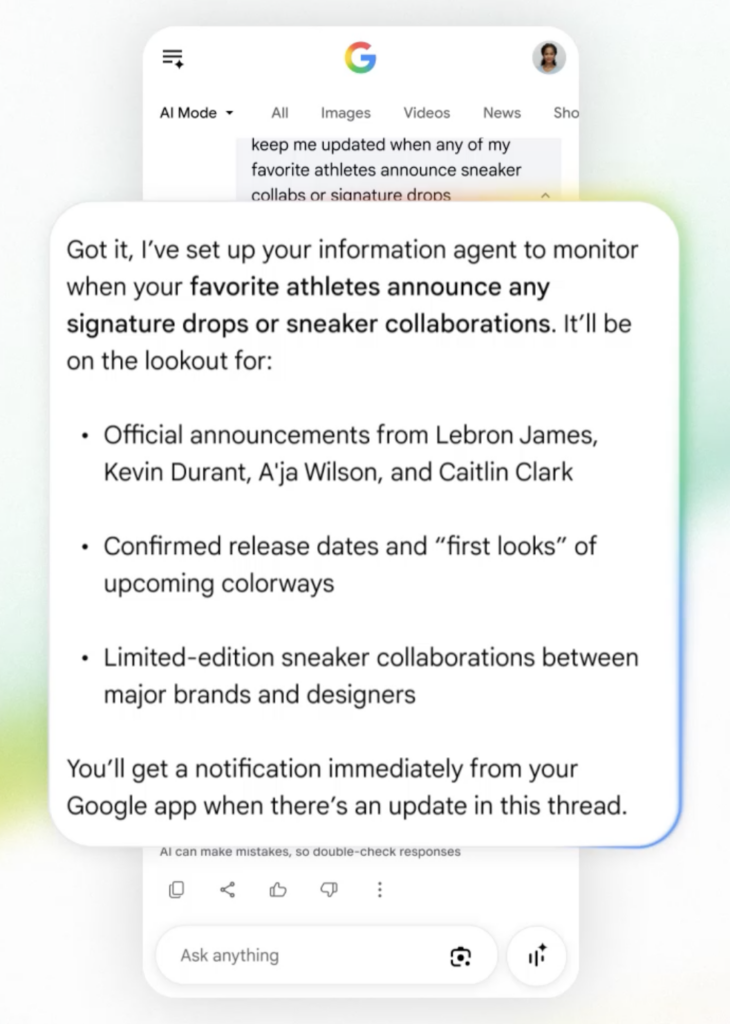
Information agents are AI-powered agents that run in the background of a user’s Google account, around the clock, without them having to search for anything. A user sets a brief once (say, they’re looking for a flat in a specific area, within a specific price range, with certain features) and the agent takes it from there.
It monitors the web continuously: news sites, blogs, social posts, real-time data on prices and availability. When something matches, it sends them a synthesised update of what it found and what it recommends through the Google App. The agent watches, reasons, and notifies. The user waits, and may never visit your site at all.
That means one standing brief effectively replaces dozens of individual queries that would previously have generated distinct, trackable signals over weeks or months. So search volume, as a measure of demand, will start to misrepresent what’s actually happening.
This makes impressions a more important metric to watch. If your content is consistently part of what an agent draws on when synthesising its updates on a topic, you’re reaching users in a meaningful way even when they don’t click through. Clicks still happen (at a lower, albeit in theory more qualified rate), but for content being cited by agents, the impression is increasingly the signal that shows your content is being found.
This raises questions that don’t have clear answers yet: how do you measure any of this? Will there be a view in Google Search Console showing which URLs have been cited in agent-synthesised updates? If notifications come through the Google App, will those impressions and clicks be trackable at all? Attribution in an agent-driven search environment is still something the industry has to work out.
This same logic (fewer active searches, more passive consumption, measurement lagging behind the product) runs directly through what Google is doing in local and commerce as well.
Agentic booking
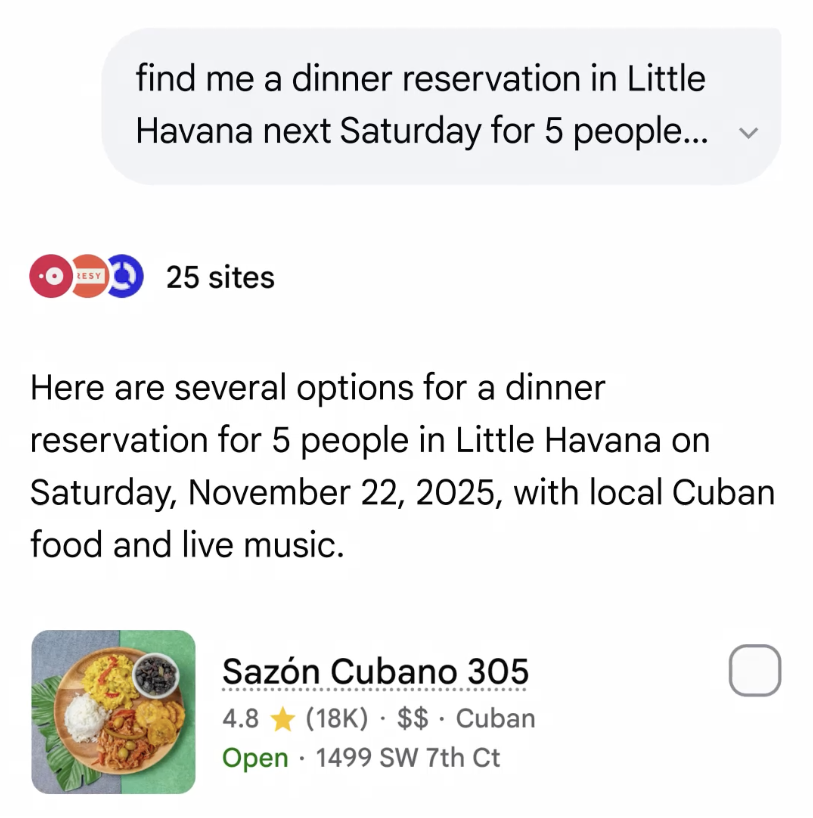
Agentic booking takes the same underlying idea (an AI agent acting on your behalf) and applies it to transactions. Instead of synthesising information and sending you a summary, the agent makes a booking. It finds a restaurant, event or service that fits your preferences, checks availability, and makes the booking. For brands in any service category where bookings are the conversion, this raises an immediate question: can an agent actually complete a booking on your site? For most, the honest answer is no, and the reason comes down to how sites are built.
Most sites are built for patient human visitors. Most of the time, a customer can navigate a complex path to purchase. Agents can’t. An agent reads your site the way a very literal machine would: it looks at the raw code underneath the page so if your booking form only appears after a button is clicked and a piece of JavaScript runs, the agent may never see it. If the key actions on your site rely on JavaScript to exist at all, they are effectively invisible to an agent trying to complete a task.
Agent-ready sites keep key information and actions in the raw HTML: prices, availability, booking steps, contact details. Further to this, structured data, the machine-readable markup that tells Google what your page is actually about, needs to be accurate and complete, not a box-ticking exercise.
Beyond this, there’s a broader set of protocols being standardised that describe what full agent-readiness actually looks like. Web MCP (Model Context Protocol) means your site can communicate its own capabilities directly to an agent, rather than the agent having to navigate it like a customer would. AP2 and APC are payment protocols that allow agents to complete transactions on a customer’s behalf, without them needing to be present at checkout. A2A (Agent-to-Agent) lets agents across different services hand off to each other. UCP connects all of these into a single system.
Together, these protocols make it possible for a customer’s intent to be fulfilled end-to-end seamlessly, from discovery to payment, without them touching a single page. Most sites aren’t implementing these yet, but it’s the standard being built toward, and the sites that get the groundwork right now will be better placed when it arrives.
Cloudflare’s IsItAgentReady.com is a useful starting point for diagnosing where a site currently falls short against these criteria.
We’re moving from AI that suggests to AI that acts. Nowhere is that more visible than in what Google has built for shopping.
Universal Cart
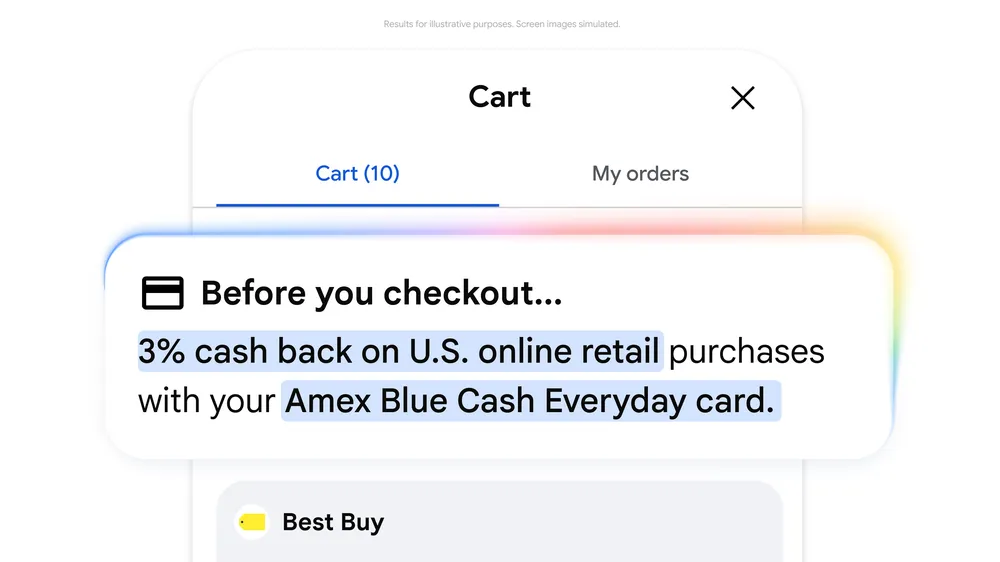
Universal Cart is Google’s new cross-surface shopping cart. The idea is straightforward: rather than having a separate cart on every retailer’s website, you have one persistent cart that lives in your Google account and works everywhere. You can add a product while searching on Google, add another while watching a review on YouTube, add a third while reading an email in Gmail, or while chatting with Gemini, and all of it lands in the same place. Google then works in the background to monitor prices across merchants, surface deals, and alert you when the moment to buy looks right.
For e-commerce brands, Universal Cart changes what you’re competing on. It’s no longer just about which page ranks for which query but whether your product data is complete and readable enough for Google’s agents to find, compare, and surface it.
In practice, that means availability, pricing, deals, and specific product attributes all need to be consistent and up to date across your site, in your structured data, and Google Merchant Centre.
Universal Cart is explicitly built to find deals. That’s the core value proposition: Google finds you the best price without you having to go looking. Sites that consistently signal promotions, price drops, and offers stand to benefit from that, because deal signals become discovery signals. The agent finds them because finding deals is the job. Premium or high-price-point brands that compete on dimensions other than price face a harder question: how do they communicate the value that makes their product the right choice in a system that is, at its core, optimised to surface the cheapest option?
That question connects to the broader shift Universal Cart represents in how people shop. Like information agents in search, Universal Cart moves the user into a passive state. They’ve told Google what they want; now they wait to be notified when the right moment arrives. Again, the user is searching less. They set an intent once, and then the system watches for it.
If search volume is what SEO teams use to forecast, and a meaningful portion of demand is now being expressed as standing agent instructions rather than active queries, search volume data is increasingly undercounting what’s actually out there. Do forecasting models need to shift toward product-level impression signals, or some measure of topic-level demand, rather than raw keyword volumes? The forecasting and measurement framework will need to evolve.
The other dimension is personalisation. Google’s personal intelligence means agents don’t just match products to queries, they match them to individual shoppers, based on context, preferences, and past behaviour. That puts a premium on specificity in your product data: not just that you sell trainers, but which trainers, for what specific use, at what price point.
We’re still testing how you effectively communicate that specificity, but structured data and entity optimisation around your products are the obvious starting points.
Bottom line
For SEO teams, the implications from these three announcements land in three places.
Measurement: as more of the customer journey moves through agents rather than direct searches, impressions become a more important signal than clicks, and how attribution works in that environment is something that needs to evolve.
Site architecture: agent-readiness means structured data that’s accurate and complete, key actions accessible in raw HTML rather than JavaScript, and an understanding of the protocol infrastructure that defines what fully agent-ready actually looks like.
Product data: Universal Cart doesn’t find pages, it finds products, which means the competitive surface shifts from page rankings to data quality. How consistent and specific your product information is across your site, your structured data, and Google Merchant Centre is what will determine whether an agent can find, compare, and surface what you’re selling.