

Travelers are asking AI where to stay, what neighborhoods are best for families, and which restaurants locals actually recommend. And they’re building entire itineraries before visiting a single booking site.
For hotels, airlines, and destinations, AI visibility depends on one thing: freshness. Outdated information disappears from recommendations within weeks, while properties maintaining current details stay visible.
This guide covers how to keep your property, destination, or experience in rotation so AI systems include you in travel recommendations.
New to AI Visibility? Start here to understand what it is and why it matters.
Common Assumptions vs. What We’re Actually Observing
Before we get tactical, it’s worth clearing up a few assumptions we see circulating because there’s a gap between what the industry thinks works and what we’re actually seeing perform.
Working with brands like Hilton Hotels, Hornblower Group, TUI , among others has given us the opportunity to test at scale and see patterns emerge. We treat this like scientists: hypothesize, test, validate. And here’s what the data is showing us:
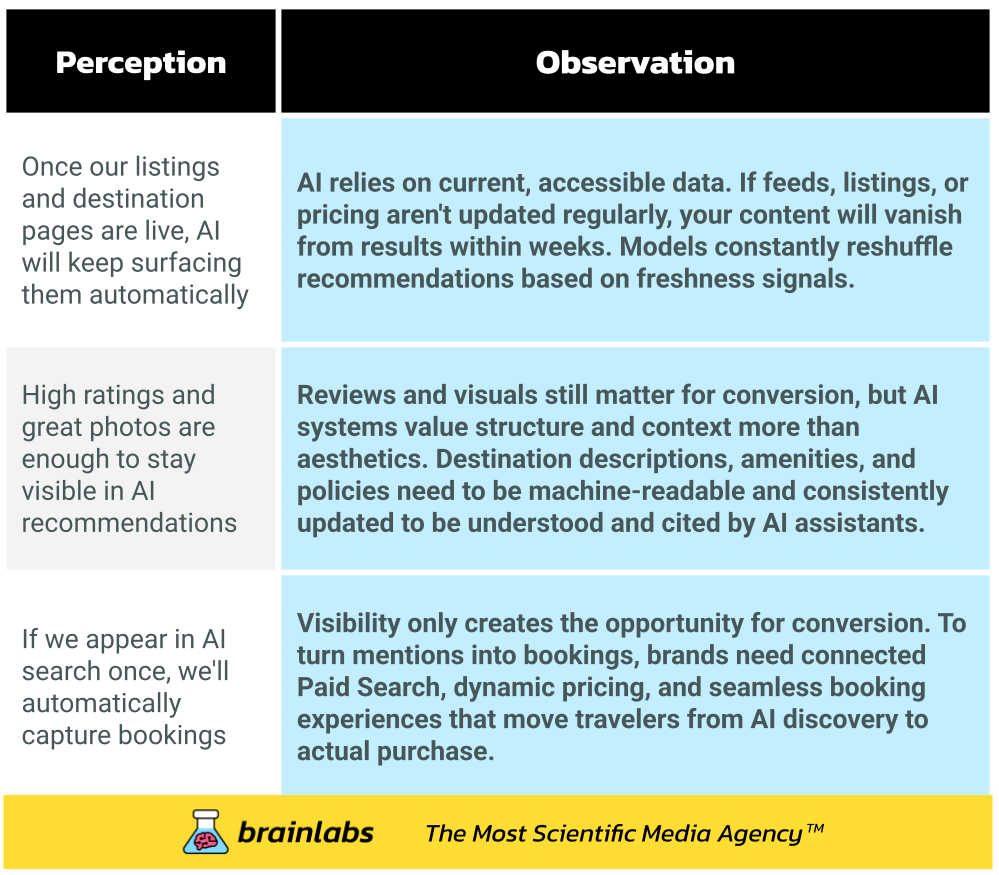
That last point is critical: AI visibility is the top of the funnel, not the bottom. You still need a complete conversion strategy.
What Actually Drives AI Visibility for Travel & Hospitality Brands
1. Maintain AI-Readable and Time-Aware Content
For travel brands, AI visibility is built on recency, relevance, and contextual depth.
AI assistants constantly update their understanding of destinations, pricing, and experiences, which means brands must operate with the same agility. Stale content quickly disappears from search results and AI-generated summaries, while accurate, up-to-date information continues to be referenced and reused.
Destination pages, itineraries, and experience descriptions should be updated frequently to reflect new seasons, events, local festivals, or special offers. Automating content audits and refresh cycles helps flag outdated copy and expired links before AI systems notice and deprioritize you.
Think of it this way: if your “Summer 2024” promotion is still live in November 2025, AI models interpret that as a signal you’re not maintaining your content. They move on to competitors who are.
2. Structure Destination and Amenity Data Clearly
Ensure structured destination and amenity data is in place for Google’s AI search, but remember that clarity matters more than markup alone. Independent AI models often ignore schema entirely.
Write descriptions in plain, conversational language so AI systems can easily interpret them. Including key factual details (exact location, price ranges, specific amenities, unique experiences, accessibility features) improves how AI summarizes and cites your brand.
Don’t write for SEO robots. Write for travelers, but structure it so machines can parse meaning. “Located in the historic Marais district, 5-minute walk from Le Marais Metro, with rooftop terrace and 24-hour concierge” is infinitely more useful than “Luxury boutique experience in Paris.”
3. Build FAQ Content Around Traveler Intent
Questions like “best time to visit St Tropez,” “top hotels for families in New York,” or “hidden gems in Buenos Aires” mirror the way people speak to AI assistants.
Develop and automate FAQ-style content addressing these natural language queries. This increases your visibility in conversational searches and gives AI systems structured content they can confidently surface when travelers ask similar questions.
Mine your customer service inquiries, booking questions, and review comments to find the actual language travelers use. Then create content that answers those questions directly.
4. Enhance Accuracy With Machine-Readable Location Data
Real-time pricing feeds, availability calendars, and accurate location information help AI systems verify your data before recommending you.
When AI detects consistency across your website listings, review platforms (TripAdvisor, Google Maps), and OTA profiles (Booking.com, Expedia), it treats your brand as a trusted source for travel recommendations.
Inconsistent pricing between your site and third-party platforms signals unreliability. Make sure your data is synchronized everywhere, or AI will choose the competitor who maintains better data hygiene.
5. Connect Multiple Touchpoints for Reviews and Social Proof
AI systems evaluate credibility through distributed signals. Recent reviews on Google, TripAdvisor, and Yelp contribute to how confidently AI recommends you.
But freshness matters here too. A property with 500 reviews from 2019-2021 and nothing recent looks abandoned. Continuous review generation (even just a few per month) signals that you’re actively operating and serving guests.
Encourage post-stay reviews through automated follow-ups, and respond to reviews publicly. AI models can detect engagement patterns.
6. Integrate Paid Search to Capture High-Intent Travelers
AI visibility gets you into the consideration set. Paid Search and dynamic creative optimization capture travelers when they move from research to active booking.
This ensures that visibility converts into revenue and that every step of the journey (from AI conversation to booking confirmation) remains connected. Budget for retargeting campaigns that catch travelers who discovered you through AI but haven’t completed booking yet.
In travel, the brands that refresh the fastest and answer the clearest will be the ones AI chooses to remember.
Proving AI Visibility Impact (When Bookings Are the Bottom Line)
Measuring AI visibility in travel requires connecting discovery metrics to actual booking behavior.
Traditional metrics like impressions and clicks don’t tell you whether AI recommendations are driving revenue. You need frameworks that tie AI visibility to booking conversions, not just website traffic.
Here’s what sophisticated travel brands are tracking:
Share of Voice in AI responses – How frequently does your property or destination appear in AI-generated travel recommendations relative to competitors? Platforms like Profound and AirOps offer monitoring for travel-specific queries.
Citation patterns for high-value queries – Are you being recommended for premium searches (“luxury hotels in Turkey”) or just generic ones? Does your brand appear in itinerary planning or just accommodation searches?
Correlation modeling to booking revenue – Track when your property or destination appears in AI responses for specific travel queries (e.g., “family-friendly hotels in Barcelona” or “best boutique stays in Austin”), then map that visibility against corresponding increases in website traffic, booking inquiries, completed reservations, and revenue for those date ranges or property types.
If you’re suddenly appearing more frequently in AI recommendations for weekend getaways, you should see measurable lifts in weekend booking volume. Build dashboards that overlay your AI visibility data with your booking system and revenue analytics to demonstrate direct ROI to leadership.
Speed and Clarity Win in Travel
AI visibility doesn’t replace your existing content strategy, SEO, or performance marketing. It amplifies them by adding a layer of real-time, machine-readable signals.
Because competition no longer centers only on OTA placement or ad spend. It’s about becoming the brand AI systems trust enough to recommend when someone asks where to stay, what to do, or where to eat.
That’s the new equation. And the properties maintaining current information in real time, structuring content for machine comprehension, and ensuring AI can access accurate availability? They’re already winning.
The real question is: how fast can you move before your competitors take the lead with AI-powered recommendations? Luckily, we know someone who can help. 😉