

When shoppers ask AI “What’s the best running shoes for flat feet?”, your brand has seconds to be part of the answer. If you’re not, the sale goes to whoever is.
For retail and ecommerce brands, AI visibility isn’t just about being found. It’s about being recommended at the exact moment purchase intent forms. And the tactics that win are specific to how shoppers interact with AI when researching products.
This guide covers how to increase your visibility so you show up when AI recommends brands to shoppers.
New to AI Visibility? Start here to understand what it is and why it matters.
What We’ve Learned Working With Enterprise Retail Brands
Before we get tactical, it’s worth clearing up a few assumptions we see circulating because there’s a gap between what the industry thinks works and what we’re actually seeing perform.
Working with major advertisers like Estee Lauder, Lego, Samsung and the likes has given us the opportunity to test at scale and see patterns emerge. We approach this stuff scientifically—hypothesis, testing, validation—and here’s what we’ve observed:
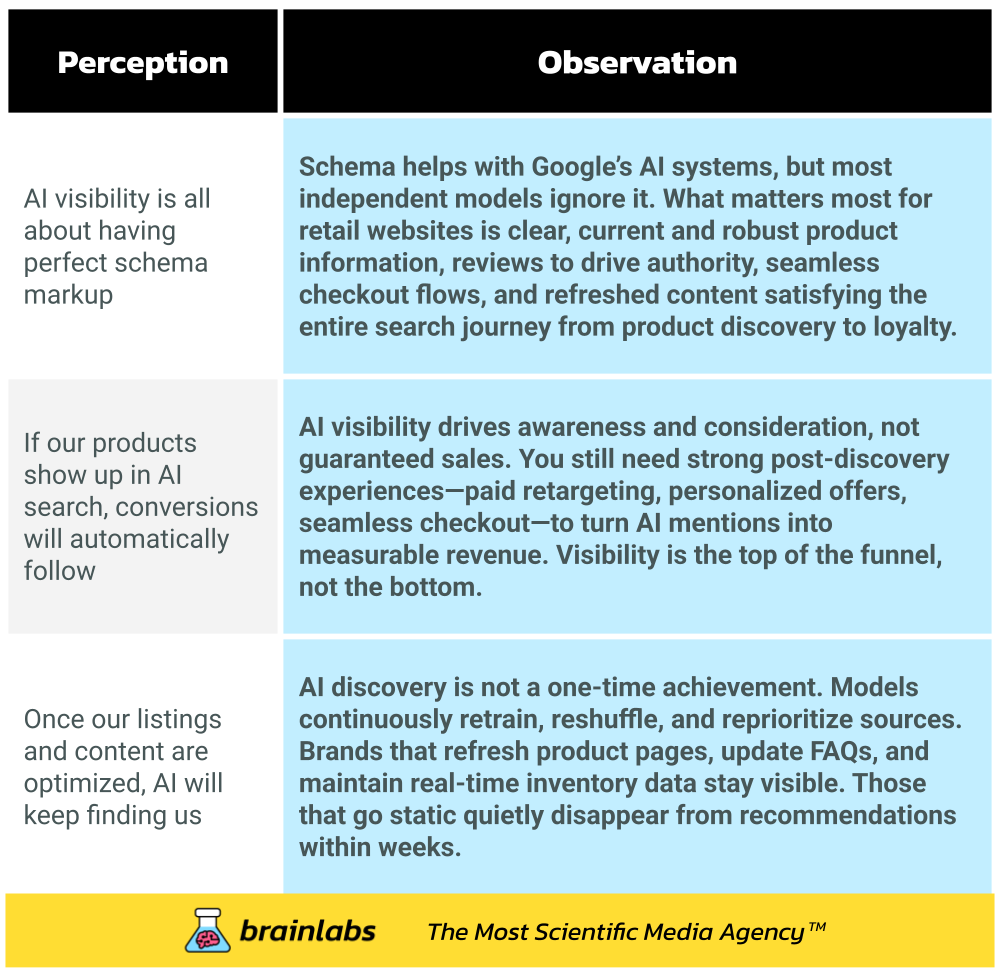
This last point is critical and often overlooked: AI visibility decays. Fast.
How Retail & eCommerce Brands Can Increase AI Visibility
1. Keep Product Information Obsessively Current
Pricing, stock levels, colors, sizes, reviews, availability — all of it needs to be accurate in real time. Use structured data for Google’s AI systems, but don’t stop there. Write clean, descriptive product copy that independent AI models can parse and understand. The clearer your content, the easier it is for AI to confidently cite you.
Most brands update product pages when launching new inventory. Winning brands update them continuously — because AI models reshuffle answers constantly, and stale pages fall out of rotation within days.
2. Automate Your Content Refresh Cycles
Manual updates don’t scale. The retailers dominating AI visibility have automated content workflows through CMS integrations or AI-driven systems that ensure pages stay fresh as consumer queries evolve.
Think about it: if your product page hasn’t been touched in six months, why would an AI model trust it over a competitor who updated theirs yesterday? Faster refresh velocity translates directly to higher inclusion rates in AI summaries.
3. Build Real-Time API Integrations
This is where most brands drop the ball. By allowing AI assistants and retail partners to access live inventory, pricing, and shipping data via AP—like Agentic Commerce Protocol (ACP)—you’re helping AI systems verify accuracy before they surface your products.
It’s the difference between an AI assistant saying “Brand X might have this in stock” versus “Brand X has 12 units available, ships in 2 days.” Confidence drives clicks.
4. Mirror Real Consumer Language in Your FAQ Content
Scrape actual questions from Google autocomplete, Reddit threads, product reviews, and forums. Cluster them by theme, then turn them into Q&A-style content that’s very easy for AI to parse and cite.
Don’t write FAQs the way your legal team wants them written. Write them the way your customers actually ask questions. “Can I machine wash this jacket?” is infinitely more valuable than “Care Instructions: Professional Cleaning Recommended.”
5. Maintain Hyperlocal Accuracy + Review Freshness
Store hours, maps, stock by location—AI systems use these signals to assess relevance and credibility. And reviews? They’re not just social proof anymore. They’re training data. Fresh, authentic reviews signal to AI models that your brand is active, trusted, and worth recommending.
Combine all of this organic groundwork with a smart Paid Search strategy to capture high-intent users immediately after AI-driven discovery. Because here’s the reality: AI visibility gets you into the consideration set, but Paid Media often closes the deal.
Measuring AI Visibility (Because Your CFO Will Ask)
This is where things get tricky — and where most brands are flying blind.
Traditional marketing metrics (clicks, impressions, rankings) don’t translate cleanly to AI visibility. You need new measurement frameworks, and frankly, the industry is still figuring this out in real time.
Here’s what we’re tracking with clients:
Share of Voice in LLM responses – How often does your brand appear in AI-generated answers compared to competitors? Third-party platforms like Profound and AirOps have monitoring tools specifically for this.
Citation frequency and placement – Are you being cited as a primary source or a tertiary mention? Are citations driving referral traffic?
Correlation models between AI visibility and business outcomes – This is the sophisticated play. Track when your brand appears in AI responses for specific product categories, then compare that visibility data against traffic spikes, conversion rates, and revenue for those same categories over the same timeframe.
If you’re suddenly appearing in AI recommendations for “wireless headphones” more frequently, you should see corresponding lifts in headphone sales. The best marketers are building dashboards that layer AI visibility metrics directly over their Google Analytics and revenue data to prove the connection.
The New Visibility Equation
AI visibility doesn’t replace SEO or Paid Media. It builds on them.
Because the future of competition isn’t about ranking for keywords or winning ad auctions alone. It’s about being the brand AI systems trust enough to recommend when your customer asks for help making a decision.
That’s the new visibility equation. And the retailers that move fastest — updating, verifying, and structuring their data in real time — will own visibility in the era of AI-assisted shopping.
The real question is: how fast can you move before your competitors take the lead with AI-powered recommendations? Luckily, we know someone who can help. 😉