

Prospective students aren’t starting on admissions portals anymore. They’re asking AI which programs have strong outcomes, where they can study affordably, and which schools actually deliver on their promises.
For universities, AI visibility determines whether you’re part of the student’s shortlist before they ever request information. The institutions showing up in these AI responses have made their academic credibility explicit and verifiable.
This guide covers how to structure your expertise so AI systems recommend your programs when students research their options.
New to AI Visibility? Start here to understand what it is and why it matters.
Common Assumptions vs. What We’re Actually Observing
Before we get tactical, it’s worth clearing up a few assumptions we see circulating because there’s a gap between what the industry thinks works and what we’re actually seeing perform.
Working with major players in the education space like DeVry University, Education Affiliates and the likes has given us the opportunity to test at scale and see patterns emerge. We treat this like scientists: hypothesize, test, validate. And here’s what the data is showing us:
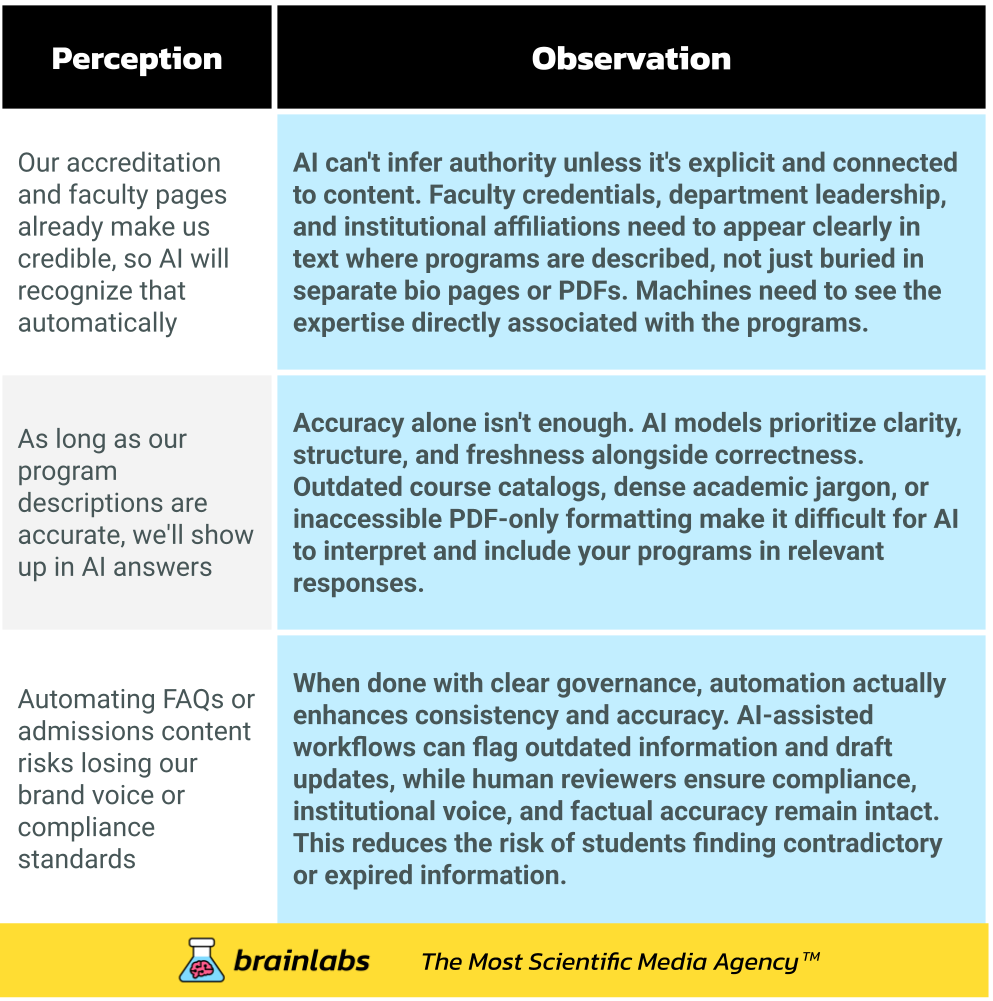
That final point is especially important: AI visibility erodes when information goes stale, and nothing damages an institution’s credibility faster than outdated admission deadlines or tuition figures.
What Actually Drives AI Visibility for Education Institutions
1. Make Institutional Authority Explicit and Verifiable
For higher education marketers, AI visibility now plays the same role that SEO once did. It determines whether your institution is part of the student’s discovery journey before they ever visit your website.
Prospective students are increasingly asking AI systems questions like: “What are the best colleges for data science?” “Which universities have strong online MBA programs?” “Where can I study abroad affordably?”
If your institution isn’t represented in those AI-generated answers, you’re invisible at the moment of consideration.
Every program or department page should make expertise and credibility explicit. Name the faculty members leading each program. List their credentials, research areas, and professional backgrounds. Highlight institutional accreditations (regional, programmatic, specialized) and cite partnerships or rankings from trusted third-party sources like U.S. News, QS, or discipline-specific accreditors.
AI systems associate institutions with reliability when information is transparent and easy to verify. A program page that says “taught by industry experts” loses to one that says “led by Dr. Maria Santos, Ph.D. in Computer Science from MIT, 15 years in machine learning research.”
2. Maintain Content Accuracy and Refresh Cadence
Admissions deadlines, tuition rates, program structures, course offerings, and institutional policies change regularly. And when they do, outdated pages erode both trust and visibility in AI systems that continuously retrain on current data.
Automating review cycles for program pages and course catalogs helps keep content aligned with AI systems’ frequently updated indexes. When prospective students ask AI about application deadlines or costs, you want the answer to reflect your current information, not last year’s catalog.
Content decay is particularly damaging in education because students are making multi-year, high-investment decisions. Stale information signals institutional neglect.
3. Turn Educational Assets Into Discoverable Expertise
Webinars, virtual open houses, faculty lectures, and student Q&A sessions are filled with natural human language and verified knowledge. These are exactly the signals AI systems interpret as credible.
Repurposing those events into structured content (blog recaps, FAQ blocks, program explainers, outcome showcases) gives your institution more “AI-readable” content while also serving human audiences who want authentic insight into campus life and academic quality.
When a dean discusses program innovations or an alumnus shares career success stories, that expertise should become multiple pieces of content AI can parse and reference. Don’t let valuable knowledge stay locked in video files or event archives.
4. Apply Schema Strategically While Prioritizing Clear Writing
Use schema markup for courses, events, programs, and organizational details to support visibility in Google’s AI ecosystem (Gemini and SGE). This structured data helps Google understand your offerings.
But don’t rely on schema alone. Independent AI models often ignore technical markup entirely. Prioritize clarity in your actual writing, since most AI systems rely on plain, contextual language more than structured data.
Write for both humans and machines: “Bachelor of Science in Data Science, 120 credits, ABET-accredited, 95% job placement rate within 6 months” is infinitely more useful than vague claims about “preparing tomorrow’s leaders.”
5. Build and Maintain FAQ Ecosystems That Mirror Student Questions
Common student queries “How do I apply?” “What scholarships are available?” “Is this program accredited?” “Can I transfer credits?” “What’s the job placement rate?” create structured information layers that AI models can easily retrieve and reuse.
Building FAQ pages around these recurring questions, with clear and current answers, makes it easy for AI systems to surface your information accurately when students ask similar questions.
Mine your admissions inquiries, chatbot logs, and campus visit questions to find the exact language prospective students use. Then create content that directly addresses those concerns in that language.
6. Link to External Validation and Third-Party Sources
AI systems evaluate institutional credibility partly through association. Linking to accreditation bodies, ranking organizations, industry partnerships, and government education databases signals that you operate within a verified academic framework.
This isn’t about driving traffic away from your site. It’s about demonstrating to AI that your institution exists within a legitimate higher education ecosystem. Schools that cite reputable external sources get cited themselves more frequently.
When program information is current, transparent, and backed by verifiable credentials, AI systems don’t just surface it. They trust it enough to recommend it to students.
Proving AI Visibility Impact (When Enrollment Is the Bottom Line)
Measuring AI visibility in higher education requires connecting discovery metrics to actual enrollment outcomes.
Traditional metrics like clicks and impressions don’t tell you whether AI recommendations are driving applications and matriculation. You need measurement frameworks that tie AI visibility to actual institutional growth.
Here’s what sophisticated institutions are tracking:
Share of Voice in AI responses – How frequently does your institution appear in AI-generated program recommendations relative to competitors? Platforms like Profound and AirOps offer monitoring for education-specific queries.
Citation patterns for high-value programs – Are you being recommended for competitive programs (engineering, business, healthcare) or just general inquiries? Does your institution appear when students ask about specific specializations or career outcomes?
Correlation modeling to enrollment metrics – Track when your university appears in AI responses for specific programs (e.g., “best online MBA programs” or “affordable computer science degrees”), then map that visibility against corresponding increases in program inquiries, application starts, admitted student yield, and enrollment for those same programs over the same timeframe.
If you’re suddenly showing up more frequently in AI recommendations for nursing programs, you should see measurable lift in nursing applications. Build dashboards that overlay your AI visibility data with your CRM enrollment funnel to demonstrate ROI to leadership and your board.
Academic Credibility Is the New Visibility Currency
AI visibility doesn’t replace your existing content strategy, SEO, or paid acquisition. It amplifies them by adding a layer of machine-readable academic credibility.
Because competition no longer centers only on search rankings or campus visit conversions. It’s about becoming the institution AI systems trust enough to recommend when a student asks for guidance on where to invest their future.
That’s the new equation. The institutions that communicate expertise clearly, update information continuously, and present data in AI-readable ways will be the ones that show up first when students ask the machines where to apply.
The real question is: how fast can you move before your competitors take the lead with AI-powered recommendations? Luckily, we know someone who can help. 😉