


For the past two decades, search gave marketers something rare: a relatively clean line from query to click to conversion. But even before AI entered the picture, that simplicity was eroding. More channels (many with no real click attribution, like podcast or CTV), cross-device tracking challenges and cookie deprecation are just a few of the challenges making attribution messier.
Then AI visibility disrupted the one channel that still felt trackable.
Now, when someone asks ChatGPT “Which CRM is best for small businesses?” the decision often happens right there. No click. No visit. No pixel to track. The buyer journey that used to flow through your website now bypasses it entirely.
This shift requires the same kind of rethinking that CTV demanded: new approaches, new KPIs, new ways to connect visibility to business outcomes. Similar to how streaming ads forced marketers to measure full-funnel impact differently, AI visibility requires moving beyond click attribution to prove value.
In our previous piece, The Untrackable Helper, we explored how AI assistants are reshaping discovery. This piece takes that conversation further: if influence is happening before the click (or without one at all), what should we measure instead?
The Honest State of AI Visibility Measurement
The challenge isn’t that AI makes marketing unmeasurable. It’s that measurement has moved upstream, to a place where standard analytics can’t see.
You can’t track whether a ChatGPT mention drove consideration three weeks later or influenced a purchase decision that never touched your site. That’s the reality. But you’re not flying blind. There are practical ways to quantify whether your AI visibility efforts are working and whether they’re driving business impact.
This guide focuses on what you can actually track, what matters for outcomes, and how to build evidence that AI visibility is contributing to growth.
The Five Metrics That Matter for AI Visibility
Here’s what you should be tracking to understand and prove your AI visibility performance:
1. AI Visibility Volume (Brand Mentions and Citations)
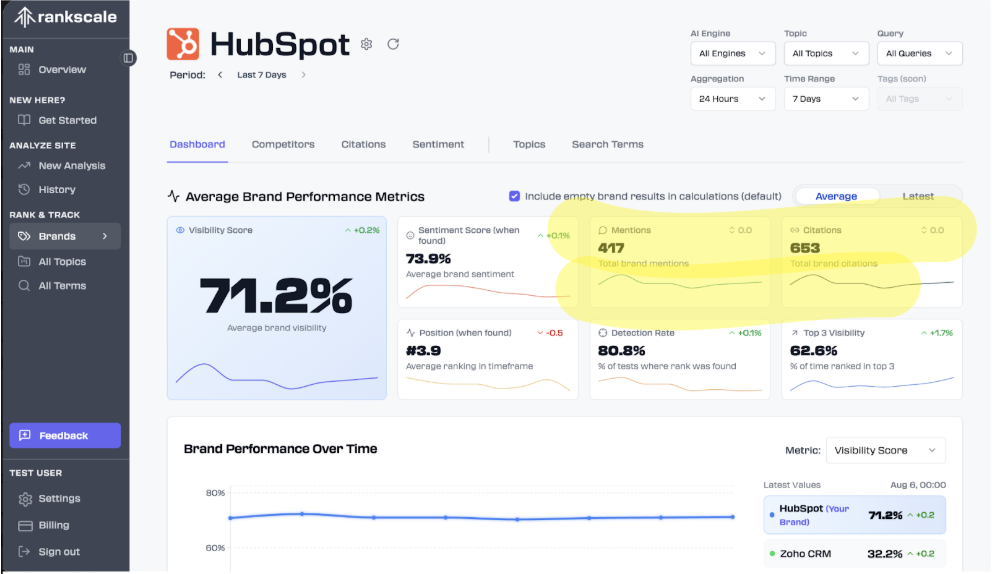
Rankscale Mentions & Citations
This is your baseline: how often your brand appears in responses from ChatGPT, Claude, Perplexity, and other LLMs when users ask relevant questions.
What to track: Total number of brand mentions and citations across LLM chatbots over time. Volume matters because you need to establish a baseline before you can correlate changes to other metrics like branded search or conversions.
Why it matters: If your mention volume is trending up, it means more people are being exposed to your brand through AI systems. If it’s flat or declining while competitors rise, you’re losing ground in an increasingly important discovery channel. You can’t prove that an uptick in branded search came from AI visibility unless you’re tracking whether AI mentions actually increased during that same period.
2. AI Visibility Ranking (Share of Voice Against Competitors)
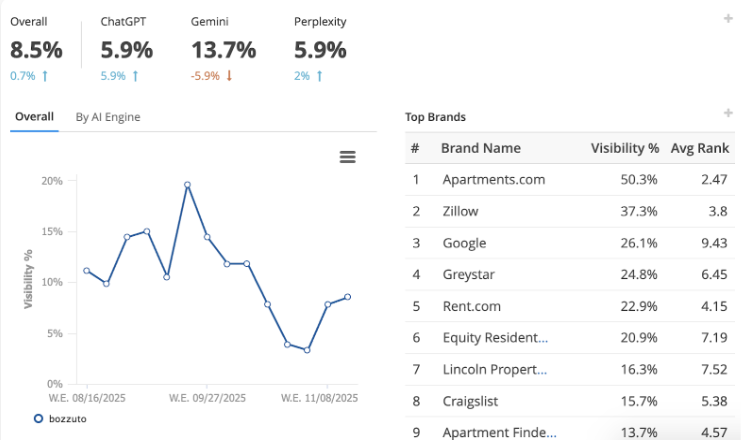
seoClarity AI Search Visibility Tracking
Volume tells you how often you appear overall. Your AI Visibility %tells you how often you appear for the prompts and topics that matter most to your business.
What to track: Your percentage of mentions against a defined keyword and prompt list across LLM chatbots. Start by identifying the high-intent questions your customers ask when researching solutions in your category. Then measure your share of mentions compared to competitors for those specific prompts.
Why it matters: If you’re not mentioned in AI responses for your core topics, you don’t exist in that buyer’s consideration set. Share of voice is the clearest indicator of whether you’re winning or losing visibility in the channels that are replacing traditional search for many users.
3. AIO Tracking (Google AI Overviews Volume and Visibility)
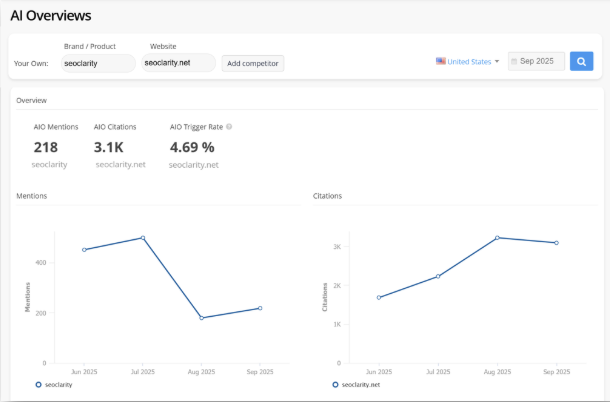
seoClarity AI Overviews Tracking
Google’s AI Overviews (AIOs) deserve separate attention because Google still drives significant discovery traffic and AIO inclusion signals strong E-E-A-T.
What to track: How often you appear in AI Overviews and what percentage of your target keywords trigger AIOs that include your content. Google has confirmed that AI Overviews and AI Mode show up as clicks and impressions in Search Console, but they’re aggregated with all results (which makes it difficult to isolate AIO-specific insights, though it’s better than nothing).
Why it matters: AIO inclusion suggests your site is recognized as a high-authority source. This is both a visibility win and a credibility signal. If you’re showing up in AIOs, you’re likely also being recognized by other AI systems that value similar authority markers.
4. AI Visibility Scoring (Quality and Context of Mentions)
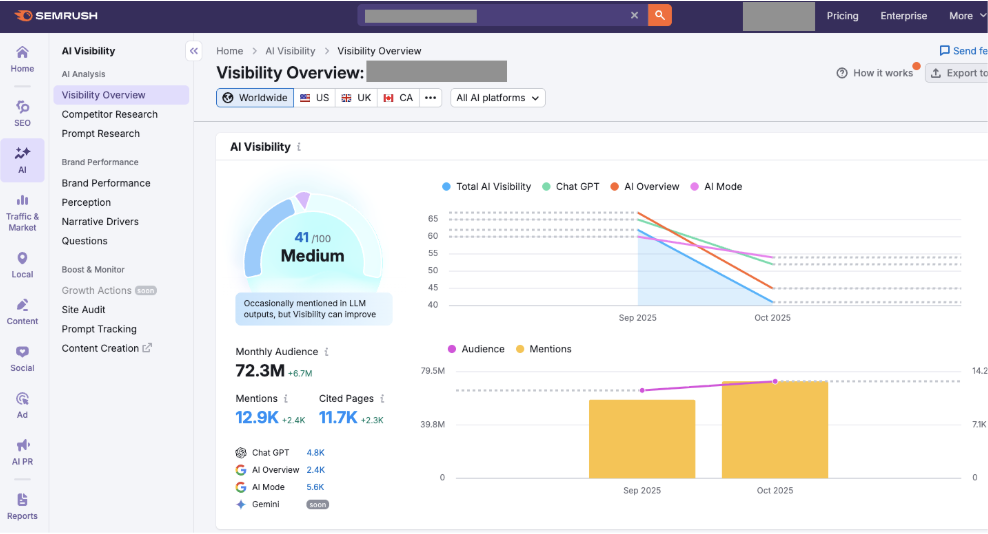
Semrush AI Visibility Score
Not all mentions are equal. Being cited with a link in the top recommendation is different from being mentioned in passing at the end of a list. AI visibility scoring lets you measure the quality and context of your appearances, not just the quantity.
What to track: Different platforms score this differently, but the goal is to account for factors like mention position, whether you’re cited with a link, the sentiment of the mention, and how prominently you’re featured in the response. If you really want extra credit, figure out how to weight it toward higher visibility on prompts with more commercial intent.
Why it matters: This addresses the diminishing importance of “position” in AI responses (which are conversational, not ranked lists) and helps you understand whether your mentions are actually driving consideration or just background noise. A high score means you’re not just visible, you’re being recommended.
5. AI Referral Traffic
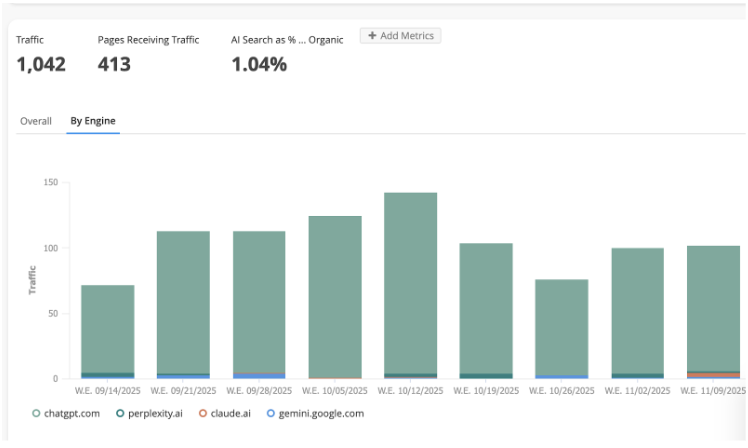
seoClarity AI Search Engine Site Analytics
GA4 and Adobe Analytics currently categorize visits from ChatGPT, Claude, and Perplexity as referral traffic. This is your most direct signal that AI systems are sending users to your site.
What to track: Isolate traffic from AI platforms specifically, monitor volume and trends over time, and compare engagement and conversion rates against other traffic sources.
Why it matters: This is the clearest evidence that AI recommendations are driving actual visits. Rising AI referral traffic means your visibility efforts are translating into real consideration and site engagement. (We believe AI referral traffic should count as organic, by the way. These users are discovering you through a search-like experience, not through paid placement or social browsing. Consider regrouping this data under your organic reporting to get a clearer picture of total search-driven discovery.) While overall referral traffic is typically still low relative to other sources, many advertisers see significantly higher conversion rates, meaning the traffic you do get is extremely valuable. This makes sense since the AI platform is giving a trusted recommendation that shortens the customer purchase journey.
Connecting AI Visibility to Business Outcomes
Tracking visibility metrics is only valuable if you can connect them to business results. This is where branded search, returning users, and direct traffic come in—but with an important caveat.
Branded Search, Returning Users, and Direct Traffic as Validation Signals
When users search for your brand name directly or return to your site without searching, it signals trust. They’re no longer discovering you—they’re seeking you out.
What to track: Branded search volume trends (Google Search Console), returning user rates in GA4, and direct traffic patterns.
Why it matters: AI often influences decisions without generating trackable clicks. Someone asks ChatGPT for recommendations, gets your brand name, then searches for you directly or types your URL. That branded search or direct visit is the downstream signal of AI-driven awareness.
The Critical Part: Map These Signals Against AI Visibility Metrics
Here’s where most marketers get this wrong. Branded search impressions could be going up because of a CTV campaign, a PR win, or seasonal demand. You can’t assume it’s AI visibility unless you’re mapping it against the AI visibility metrics above.
Build correlation dashboards that layer your AI visibility data (mention volume, share of voice, AIO inclusion, AI referral traffic) over your business metrics (branded search, leads, conversions, revenue). Look for patterns where visibility increases precede branded search or business outcome improvements.
For each metric, ask: When AI mention volume increases, does branded search follow? When AIO visibility improves, do conversions rise? When AI referral traffic grows, does pipeline expand?
The goal isn’t perfect attribution (that’s not possible yet). The goal is building evidence that AI visibility efforts are contributing to growth, even when the path from AI recommendation to conversion isn’t directly trackable.
What’s Still Emerging
Some metrics sound promising but aren’t fully practical yet:
Isolated AIO data in Search Console. Google includes it but aggregates it. You can’t segment AI-specific performance today, though this will likely improve.
Prompt-to-purchase attribution. AI platforms don’t share user journey data. You can’t track who asked what and then converted.
Real-time share of voice across all LLMs. Tools are emerging but still maturing. Expect imperfect data and some manual effort.
Start with what’s measurable now. Build toward more sophisticated attribution as tools and platforms evolve.
Where Measurement Is Heading
The industry is still figuring this out. New tools are emerging, platforms may eventually share more data, and attribution models will improve.
But you don’t need to wait for perfect measurement. The brands winning at AI visibility right now are tracking the metrics that matter (mention volume, share of voice, AI referral traffic, AIO inclusion) and using that data to prove impact and refine tactics.
Start with what’s trackable. Tie it to outcomes. Refine as you learn.
That’s how you measure AI visibility in 2025. Not perfectly, but practically enough to make better decisions and prove business value.
The brands that figure out measurement first will have a massive strategic advantage. Not because they have perfect data, but because they’re making evidence-based decisions while competitors are still guessing.