

Let’s start with something that tends to make CMOs (to say nothing of CFOs) very uncomfortable: none of your AI visibility data is accurate.
Not Profound. Not seoClarity. Not Peec, not AirOps, not whatever platform you’re piloting right now. The prompt volume numbers are probabilistic estimates. The mention rates fluctuate run to run. And the thing you most want to know, how many people actually saw an AI response that mentioned your brand this month, is, frankly, unknowable.
This isn’t a criticism of those platforms (I’m a happy customer of several of them). It’s a structural reality of the medium. And once you accept it, really accept it, it unlocks a much more actionable way to use AI visibility measurement.
First, Understand Where the Data Comes From
Before you can use AI visibility data intelligently, you need to understand what you’re actually looking at. Every measurement platform runs a set of prompts against one or more LLMs, records whether your brand was mentioned or cited, and aggregates that into a score or trend line. Where they differ methodologically is in how they estimate prompt volume. There are broadly four approaches in market:
Panel and survey-based estimation derives prompt volume from consumer panels or survey data. The advantage is that it attempts to reflect real human behavior. The disadvantage is panel-level accuracy: meaningful margin of error, particularly for niche verticals or B2B categories where panel sizes are small.
Clickstream and traffic inference uses anonymized browsing behavior to infer how much query activity is happening across AI platforms. Directionally useful for platform-level comparisons (how is ChatGPT growing versus Gemini?) but less reliable at the individual prompt or topic level.
Keyword-to-prompt modeling — the most common approach — uses existing keyword research data to estimate how many times a given prompt theme is likely being asked in AI contexts. The logic is plausible: if “best running shoes for flat feet” gets 40,000 monthly searches on Google, some proportion of that intent is probably showing up in ChatGPT or AI Mode. The problem is the conversion factor from search volume to AI prompt volume is largely assumed, and fails to account for an accepted reality that people search much differently on LLMs than they do on Google Search.
Direct API sampling runs a fixed set of prompts on a scheduled cadence and reports back what it finds. The most transparent approach because you know exactly what was asked, but it makes no claim about real-world volume.
None of these is wrong. All have genuine utility. But none is the equivalent of Google Search Console, where data is logged, deterministic, and directly tied to real user behavior. The sooner you internalize that difference, the more useful your AI visibility program will be.
The Measurement Problem Is Worse Than You Think
There’s a common critique of AI visibility measurement that focuses on platform-level uncertainty: different tools give different numbers, they disagree on which prompts matter, sentiment scoring is inconsistent. All true.
But the deeper problem isn’t the tools. It’s the medium.
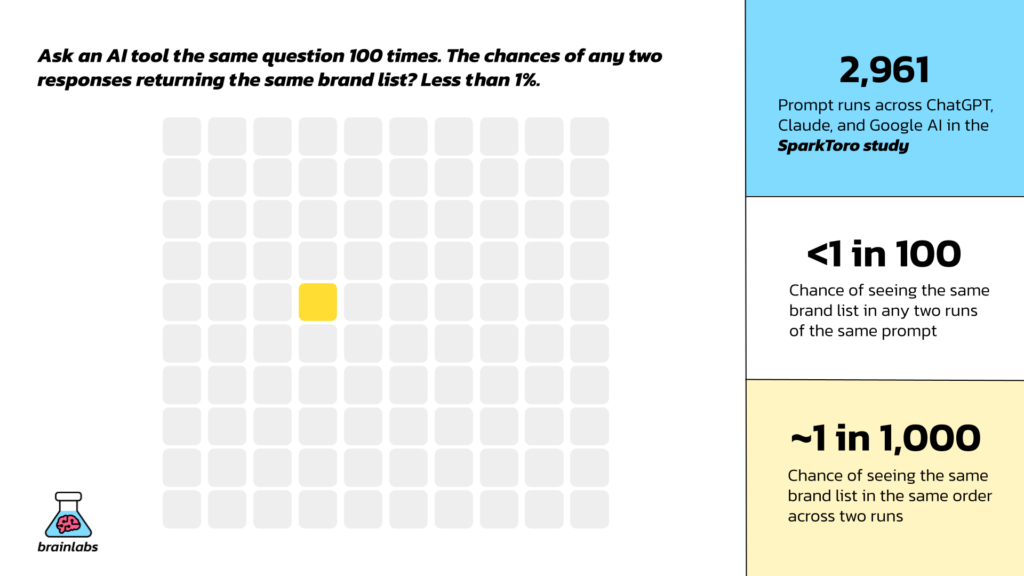
SparkToro’s Rand Fishkin published one of the most rigorous studies to date on AI response consistency. Across nearly 3,000 prompt runs through ChatGPT, Claude, and Google AI, his finding was a jaw-dropping confirmation of something we all assumed was happening (albeit on a much smaller scale): there’s less than a 1 in 100 chance that any of these AI tools will give you the same list of brand recommendations in any two runs of the same prompt. Want the same order? Closer to 1 in 1,000.
This means the concept of a “ranking”, the foundational unit of traditional SEO reporting, simply doesn’t translate to AI search. You’re not in position three. You’re mentioned in 47% of responses to a given prompt cluster. That’s not a worse version of a ranking. It’s a fundamentally different signal requiring a fundamentally different way of thinking.
Everyone Knows It’s Zero-Click. Almost Nobody Acts Like It.
Here’s where the gap between understanding and action becomes painful to watch.
Zero-click search isn’t a new idea, and the concept is simple enough: when you ask an AI assistant for the best accounting software for a growing startup, you get a trusted recommendation and you don’t then open twelve tabs to verify it. Citation links in AI responses are rarely clicked. Most people already know this.
And yet most marketing leaders go straight back to asking: “Why is our LLM click volume so low?” Or, even worse: “This is only like 1% of organic traffic, does this even really matter?”
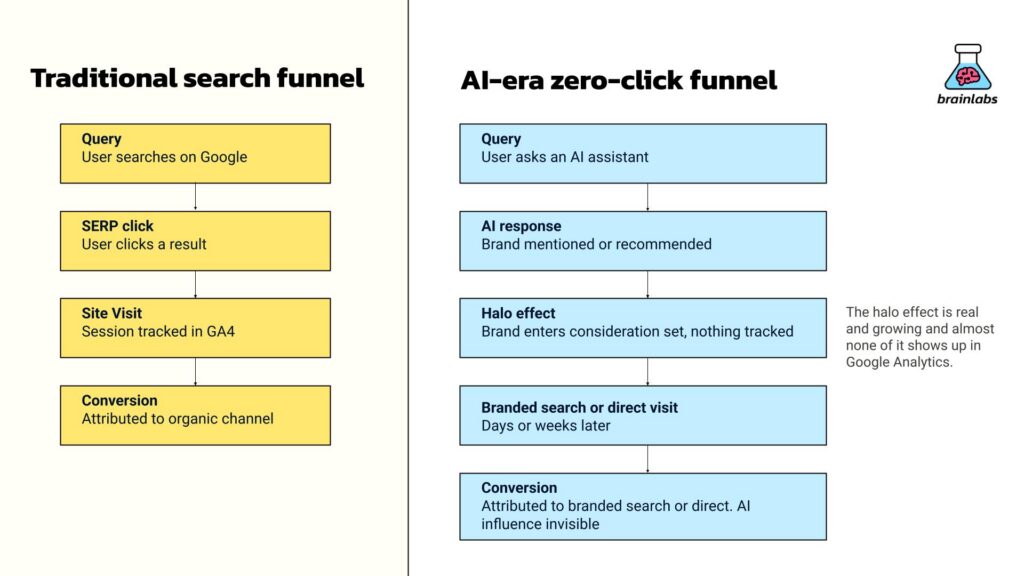
The reason isn’t ignorance. It’s attribution infrastructure. We spent two decades building a measurement stack designed to count clicks and connect them to outcomes. GA4, Search Console, UTM parameters — all of it assumes value enters through a click. When clicks stop being the primary delivery mechanism for influence, the whole stack needs reorienting, and that’s a much bigger lift than updating a dashboard.
What’s actually happening when your brand is mentioned in an AI response is something closer to a brand impression than a website visit. But, it’s like a brand impression on steroids: one from a highly trusted and objective influencer. The user absorb this commentary on your positioning, but none of it shows up in Google Analytics. However, it is often shapes the consideration set that eventually drives a branded search, a direct visit, or a purchase decision.
This is the halo effect of AI mentions. It’s real, it’s growing, and right now almost nobody is measuring it correctly.
Intelligence Over Accounting: A Different Way to Use the Data
If you can’t trust the absolute numbers, what can you trust? Trends. Competitive benchmarks. Directional signals. Prompt-level patterns. Citation source breakdowns. These are all genuinely meaningful in a world of probabilistic data — as long as you use them to generate insight and action rather than fill a reporting slide.
At Brainlabs, we frame this as “intelligence over accounting.” It’s a deliberate repudiation of the instinct to treat AI visibility metrics the same way you’d treat impression counts or keyword rankings: numbers to be reported and compared week-over-week as an end in themselves.
Here’s what that looks like in practice:
Test multiple data sources and look for convergence. If your seoClarity data and your Profound data tell the same directional story about a prompt cluster, you’re losing ground to a competitor across mid-funnel financial services queries, that signal is meaningful even if the exact numbers diverge. Convergence across imperfect sources beats false precision from a single one.
Prioritize mentions over citations. This is counterintuitive for an SEO audience trained to care about links. Intuitively, and supported by growing evidence, being mentioned in AI responses significantly influences downstream brand behavior: branded search volume, direct traffic, and ultimately conversion. The mention is the signal. The link is a bonus.
Read AI metrics alongside traditional SEO KPIs. AI visibility data doesn’t replace organic traffic analysis, it contextualizes it. If your branded search volume is rising while your organic click volume is falling, AI mentions are a plausible explanation. If a competitor’s domain authority is flat but their share of AI citations is climbing, that tells you where authority is shifting. These are the stories that AI visibility data, read intelligently, can tell.
What Useful AI Visibility Reporting Actually Looks Like
Given all of the above, here’s a practical framing for how to structure AI visibility reporting that’s honest about the data’s limitations while still being genuinely useful.
Lead with direction, not decimals. “Our mention rate on high-intent financial services prompts is up 12 points quarter-on-quarter” is a meaningful signal. “Our mention rate is 43.7%” is not, because you have no reliable baseline for what 43.7% means in absolute terms. Present trends and relative comparisons, not point-in-time snapshots.
Segment by prompt intent, not just platform. Knowing you’re mentioned more on ChatGPT than Gemini is less useful than knowing you’re visible on high-commercial-intent prompts but invisible on category-awareness prompts. The latter is actionable.
Build the halo effect into your framework. Even if you can’t measure it precisely yet, acknowledge it explicitly in your reporting. Note when branded search volume trends correlate with periods of improved AI visibility. Track direct traffic. Watch for branded search uplift following content investments designed to improve AI citation rates.
Report it alongside, not instead of, traditional metrics. AI visibility is additive to your measurement stack. Organic traffic, GSC data, and conversion rates remain essential. AI visibility data gives you a lens on what’s influencing those metrics at a layer above the click.
The Right Benchmark for This Moment
Traditional SEO gave marketers something rare: a relatively clean line from query to click to outcome. Losing that is uncomfortable, and the natural response is to reach for the nearest proxy for that certainty, even if the proxy is shaky.
But the brands that will win in AI search are not the ones who find the most convincing-looking number to put in a board slide. They’re the ones who accept the imprecision, invest in directional intelligence, and build content and distribution strategies robust enough to show up across the full ecosystem of sources LLMs draw from.
The data will get better. Measurement methodologies will mature. Attribution models will evolve to account for zero-click influence. But in the meantime, imprecise and actionable beats precise and paralyzing every time.
Your AI visibility data is wrong. Work with it anyway.
Want to understand how Brainlabs approaches AI visibility measurement for clients across retail, financial services, and B2B? Get in touch.