

By now, most marketing teams don’t need convincing that AI visibility matters. The question has shifted from “should we be thinking about this?” to “what do we actually do about it?” And that’s where a lot of brands are getting stuck, not because the opportunities are hard to find, but because acting on them requires more coordination across teams than most people anticipated.
The plays that move the needle in AI search aren’t all heavy lifts. Some of them are genuinely quick wins, and may even come straight from the existing SEO wishlist. But almost all of them sit at the intersection of more than one team, and knowing which team needs to own what is just as important as knowing what to do in the first place. Your SEO team can’t achieve success on their own, so here’s where I’d start.
AI can only see what you show it
The first thing I’d make sure of is that AI can actually read your site. It sounds basic, but it’s the kind of thing that gets missed precisely because everything looks fine from the outside.
AI search engines can only read what’s visible to them through server-side rendering. If your site uses JavaScript to load content on the client side, there’s a real chance AI agents are working from a partial picture of your brand.
To understand why this matters, it helps to think about what’s actually happening when someone asks an AI engine a question. The AI isn’t browsing your website the way a human would. It’s reading the version of your site that gets delivered directly from your server, before any JavaScript runs. If your navigation, your product descriptions, or your most important content only appears after the page has loaded and scripts have executed, the AI may simply never see it. It’s drawing conclusions about your story from an incomplete picture, and you’d have no way of knowing.
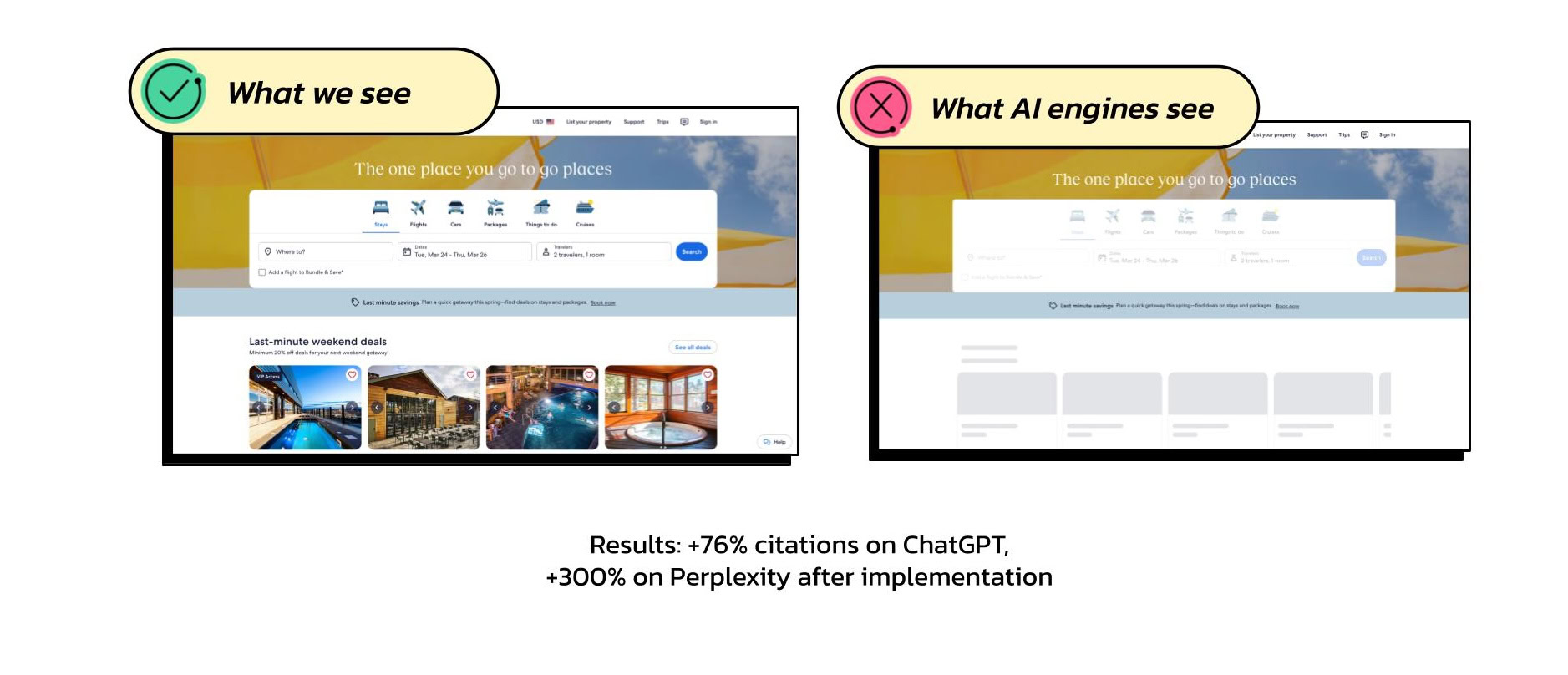
Fixing this requires your engineering and development teams, not your SEO team. Your SEO team can audit the site, identify which pages are affected, and define what needs to change. But the actual work sits in a development sprint, which means someone at leadership level has to make the case for it alongside product priorities. Paid media teams are useful here too, since they often have the clearest view of which pages are driving the most commercial value and should be prioritized first.
Freshness and credibility signals AI engines are actually reading
Once AI can read your site, the next question is whether it trusts what it’s reading. AI answer engines factor in how recently your content was updated when deciding what to cite, and one of the clearest ways to communicate that is through schema markup.
Schema markup sounds technical, and in implementation terms it is, but the concept is straightforward. It’s a small addition to your site’s code, invisible to human visitors, that tells search engines and AI engines specific things about your content: when it was last updated, who wrote it, what format it’s in. For video content specifically, schema can signal to AI that a video exists on a page, what it covers, and when it was produced. Without that signal, the video might as well not be there from an AI visibility standpoint.
The reason most brands haven’t done this isn’t that it’s prohibitively difficult. It’s that schema sits in the gap between SEO and development, with neither team formally owning the deployment process. The fix is a standing workflow: The SEO team should define what schema is needed on which pages, and development team should then deploy it as part of routine publishing rather than treating each addition as a one-off project. Creative and social teams belong in this conversation as well because they’re the ones producing the video content that most benefits from being marked up correctly.
Stop optimizing for keywords. Start optimizing for topics.
This is the single biggest unlock I see in AI search right now, and it’s also the one that requires the most fundamental shift in how teams work together.
AI doesn’t rank pages for individual keywords the way traditional search does. It rewards content that’s organized around themes and demonstrates comprehensive expertise across a subject area. So if your site has twenty pages that each touch on their own topic without any of them going into enough depth to fully own it, you’re likely being passed over in favor of a competitor whose content is structured to show genuine depth.
The technique that reveals which themes AI is actually favoring is embeddings analysis. Without getting too deep into the technical detail: AI engines understand language by mapping words and ideas into clusters based on how closely related they are. Embeddings analysis lets you see those clusters, so you can understand which themes and content structures AI is treating as authoritative in your category, and where your own content does or doesn’t match.
What this produces is a data-backed topic framework: a map of the themes your content should be organized around if you want to show up in AI answers. But here’s where the organizational piece becomes critical. That framework is only valuable if it becomes the shared operating logic across your content, social, and PR team, not another SEO document that sits in a folder no one else opens. When your PR team is pitching stories to publications, they should be pitching around the same themes. When social is building an editorial calendar, those priority topics should be the spine of it. SEO leads the analysis, but the output has to belong to everyone.
Your website is only part of the picture
This is the point that tends to shift how people think about AI search entirely. AI answers aren’t assembled from your website alone. They’re synthesized from your site, Reddit threads, YouTube videos, forum posts, and publisher coverage simultaneously. Your brand’s AI narrative is being shaped by what exists across all of those places, not just what your team has direct control over.
The practical consequence is that a brand can have an excellent website and well-optimized content, and still be losing ground in AI search because the broader conversation around it is thin, fragmented, or pointing in different directions.
Getting this right means your SEO team needs a regular line of communication with your social and community teams, sharing which topics AI is surfacing and rewarding so that platform-specific content is informed by the same priorities. This isn’t about SEO dictating to other channels. It’s about making sure the signals that exist across the web are coherent, which only happens if there’s someone actively connecting them.
PR has a new job, and most briefs don’t reflect it yet
The last play is the one that requires the most meaningful shift in how success is measured. AI answers synthesize sentiment from your PR coverage, your community mentions, and your publisher citations all at once. A negative or inaccurate mention doesn’t stay contained to the publication where it appeared. It gets baked into what AI tells your customers about you.
So the priority is no longer just earning links from high-authority publications. It’s increasing positive and accurate mentions in the sources AI actually cites, and correcting the record where inaccurate information exists anywhere in the ecosystem. That’s a different brief than the one most PR teams are currently working from. It also means paywalled coverage, however prestigious the publication, isn’t doing the job that matters for AI visibility job. If AI engines can’t access the content to read it, they won’t cite it.
This requires your SEO team to provide PR with data on which sources LLMs are actually pulling from and where brand mentions are inaccurate or missing. PR then acts on it. Partnerships teams belong in this conversation too, because co-created content and third-party endorsements are exactly the kind of open, readable signals that build AI credibility in ways that a paywalled feature piece simply can’t.
The common thread
None of these plays are secret. The techniques exist, the data is available, and the fixes are largely understood. What’s missing in most organizations is the cross-functional process to actually execute them. Your SEO team can run the analysis and flag the opportunity, but it can’t ship a rendering fix without engineering, deploy schema without dev, align a content calendar without the content team, or redirect PR’s targeting list without a shared measurement framework.
The brands getting traction in AI search right now aren’t necessarily doing more sophisticated work. They’re the ones who’ve made AI visibility a shared priority across the organization, rather than a single team’s problem to solve alone. That shift starts with someone being willing to have the harder internal conversation, not about what the AI search opportunity is, but about who actually owns the work to go after it.