

Prospective customers are asking AI which banks to trust, whether refinancing makes sense, and which credit products fit their situation. And those conversations are happening before they ever visit your website.
For financial institutions, the challenge isn’t just discoverability. It’s credibility. AI systems won’t cite sources they can’t verify, which means data accuracy and transparency now directly determine whether you appear in financial guidance.
This guide covers how to build the trust signals that get your institution cited when AI answers financial questions.
New to AI Visibility? Start here to understand what it is and why it matters.
What We’ve Learned Working With Enterprise Financial Institutions
Before we get tactical, it’s worth clearing up a few assumptions we see circulating because there’s a gap between what the industry thinks works and what we’re actually seeing perform.
Working with major advertisers like Capital One, Bozzuto, Brookfield Asset Management and the likes has given us the opportunity to test at scale and see patterns emerge. We approach this stuff scientifically—hypothesis, testing, validation—and here’s what the data is showing us:
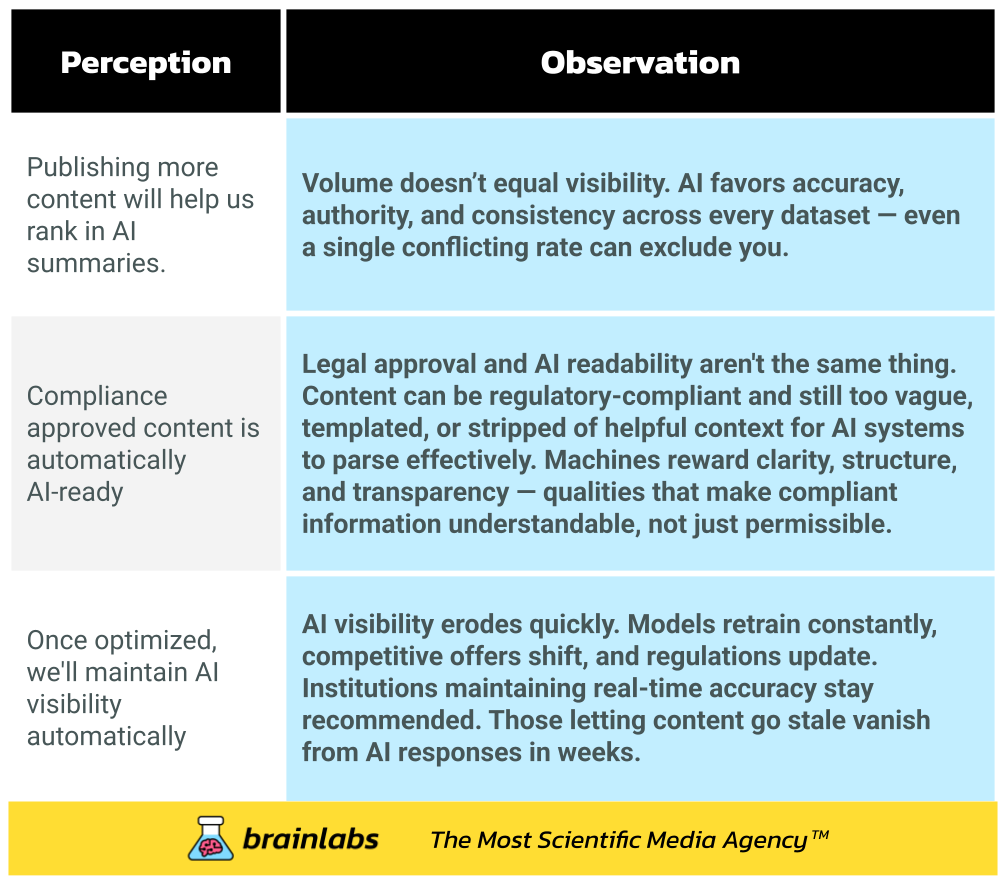
That final point deserves emphasis: AI visibility has a shorter half-life in regulated industries because trust must be continuously re-earned.
How Financial Institutions Can Increase AI Visibility
1. Treat Data Accuracy as Your Foundation
In finance, trust determines visibility. AI systems won’t recommend sources they can’t verify, which means data integrity directly controls whether you appear in results.
Interest rates, APRs, fee structures, and financial calculators must stay current to remain credible. The solution isn’t manual oversight. It’s automation. Build workflows that flag outdated information and route updates through compliance approval quickly, so AI systems always encounter accurate data.
Here’s what kills visibility: inconsistency. If your home loan page lists one APR, your calculator shows another, and a partner comparison site has a third number, AI models detect the conflict and exclude you. Even minor discrepancies between your website, paid landing pages, and third-party listings can eliminate you from consideration.
Consistency isn’t a nice-to-have. It’s the entry price.
2. Create Educational Content That Proves Expertise
AI models evaluate authority by how well you explain complex topics. In finance, that means publishing detailed guides, structured Q&As, and educational resources that demonstrate deep subject knowledge.
Turn existing expert content (webinars, advisor calls, research reports) into blog posts and FAQs written for machines to understand. This converts human expertise into signals AI systems can measure and cite.
But avoid the trap of publishing defensively. Don’t just answer questions in compliance-safe language that says nothing useful. Answer what customers actually want to know: “What credit score do I realistically need for approval?” “How does refinancing affect my tax situation?” “What’s the real difference between fixed and variable rates?”
The institutions earning AI citations are making finance genuinely accessible, not just legally defensible.
3. Make E-E-A-T Signals Explicit and Verifiable
Google’s E-E-A-T framework (Experience, Expertise, Authoritativeness, Trustworthiness) carries even more weight when AI evaluates YMYL content, which includes topics that impact financial wellbeing.
Every piece of content should display clear authorship with verifiable credentials. Include author bios for certified financial planners, advisors, and licensed professionals. Link to regulatory disclosures, professional certifications, and third-party validations wherever relevant.
Search engines like Google heavily weight demonstrated human expertise in finance. Anonymous content or generic “marketing team” bylines lose to articles written by “James Rodriguez, CFP® with 18 years in retirement planning” every time.
Make your expertise impossible to miss, or watch competitors with visible credentials take your spot.
4. Find High-Intent Keywords Hidden in Customer Conversations
Your most valuable keyword opportunities aren’t in SEO tools. They’re in the actual language your customers use when evaluating financial decisions.
Mine discovery calls, support chat transcripts, CRM notes, and service inquiries for the specific questions prospects ask before they convert. These “hidden money keywords” reveal high-intent searches where competitors haven’t established visibility yet.
Cross-reference these customer phrases against AI platforms to find content gaps. If prospects frequently ask “Can I qualify for a mortgage with freelance income?” but no authoritative answer exists, you have an opening.
The institutions dominating AI visibility in finance aren’t guessing at keywords. They’re extracting them directly from customer behavior.
5. Synchronize Everything Across Every Channel
Your messaging, rates, product terms, and disclaimers must be identical everywhere: your website, paid ads, partner sites, social channels, and comparison platforms.
When AI encounters consistent information across multiple touchpoints, it interprets that as credibility and includes you repeatedly. When it finds contradictions, you’re out.
Implement quarterly cross-channel audits covering:
- Website content (product pages, blog posts, calculators)
- Paid search campaigns and landing pages
- Third-party financial sites (NerdWallet, Bankrate, Credit Karma)
- Email and social media messaging
6. Structure Compliance Requirements to Aid (Not Block) AI Understanding
Here’s the nuance most finance marketers overlook: regulatory requirements and AI readability can coexist.
Yes, disclaimers are mandatory. Yes, legal language is required. But you can organize that content so AI systems understand both the useful information and the regulatory boundaries.
Use descriptive headers like “Eligibility Requirements” or “Important Legal Disclosures” so AI can distinguish guidance from disclaimers. Write regulatory language as clearly as regulations allow. And always lead with the helpful answer before the fine print.
The goal is compliance with utility. AI cites institutions that achieve both, not those just checking legal boxes.
Proving AI Visibility Impact (For the Executives Who Control Budgets)
Measuring AI visibility is complex, and the industry is still developing standardized approaches.
Traditional metrics like clicks and keyword rankings don’t capture what’s happening when AI provides direct answers. You need new frameworks, and most financial institutions are building them in real time.
Here’s what sophisticated teams are tracking:
Share of Voice in AI responses – How frequently does your institution appear in AI-generated financial guidance relative to competitors? Platforms like Profound and AirOps offer monitoring specifically for LLM mentions.
Citation patterns and quality – Are you cited as a primary authority or background reference? Does AI-driven traffic convert differently than organic search?
Correlation modeling to business outcomes – The advanced approach tracks when your institution appears in AI responses for specific financial products (e.g., “best mortgage lenders for first-time buyers”), then maps that visibility against corresponding increases in organic traffic, form submissions, application starts, and funded loans for those products during the same period.
If you’re suddenly showing up in more AI recommendations for home equity loans, you should see measurable lift in HELOC applications. Build dashboards that overlay your AI visibility data with your CRM pipeline metrics to demonstrate direct ROI to leadership.
The Competitive Equation Has Changed
AI visibility doesn’t replace your existing SEO or Paid Media efforts. It amplifies them.
Because competition no longer centers on keyword rankings or ad auction wins alone. It’s about becoming the institution AI systems trust enough to recommend when someone asks for guidance on major financial decisions.
That’s the new equation. And the institutions maintaining verified data in real time, structuring content for machine comprehension, and ensuring AI can access authoritative information? They’re already winning.
The real question is: how fast can you move before your competitors take the lead with AI-powered recommendations? Luckily, we know someone who can help. 😉