


Search marketing used to be complex, but it wasn’t complicated.
There were a lot of moving pieces, but the system made sense. You could learn how it worked, pull the right levers, and improve performance by applying clear best practices. You didn’t win every time, but you understood why things worked when they did.
That’s not where we are anymore.
Search today is complicated. There are more signals, more formats, and more automation than any one person can realistically reason through. Automation is making more decisions. AI is reshaping how people search. And ads are starting to show up inside those AI-driven experiences.
But the answer isn’t to fight automation or try to outsmart it. The answer is to be clear on your role as the human in the loop: the person who defines what “good” looks like and steers the machine toward outcomes that actually matter to the business.
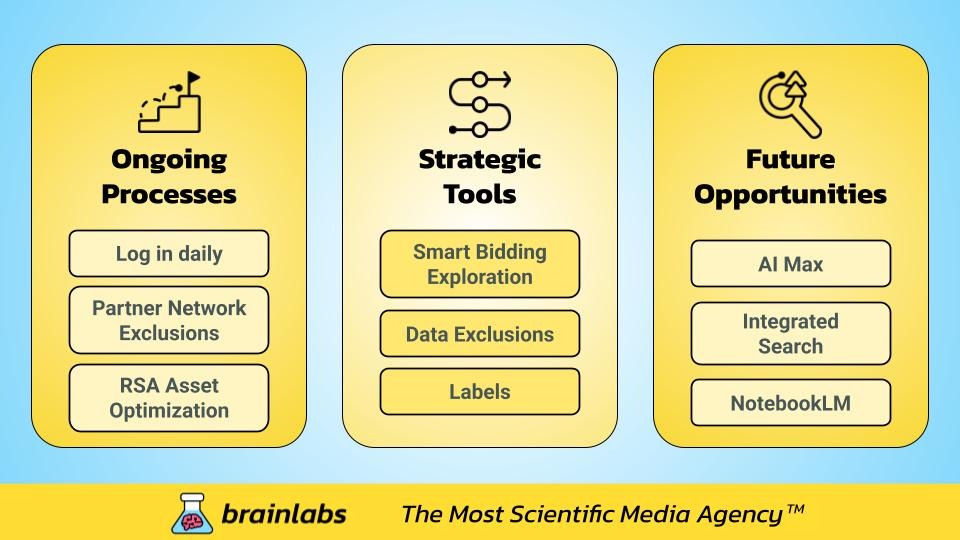
Here are nine practical things you can do in your account to do exactly that.
1. Start by logging into the actual UI (yes, really)
I know this sounds like a no-brainer but I also know that some marketers aren’t doing this as often as they should.
Log into your account daily and check your notifications. Not Search Ads 360 or Skai or any other reporting dashboard you’re using. The native Google Ads UI.
Most of the alerts you see won’t be urgent. You’ll skim them, nod, dismiss them, and move on with your day. But occasionally, one of those notifications will quietly surface something that matters right now:
- A new feature launch
- A policy change
- A measurement issue
- An eligibility shift, or
- A control you didn’t realize you had access to.
Those moments are easy to miss if you’re only living in tools built around the platform instead of the platform itself. And one of those easily missed alerts leads directly to the next point.
2. If you’re using Search Partner Network, you should be auditing it now
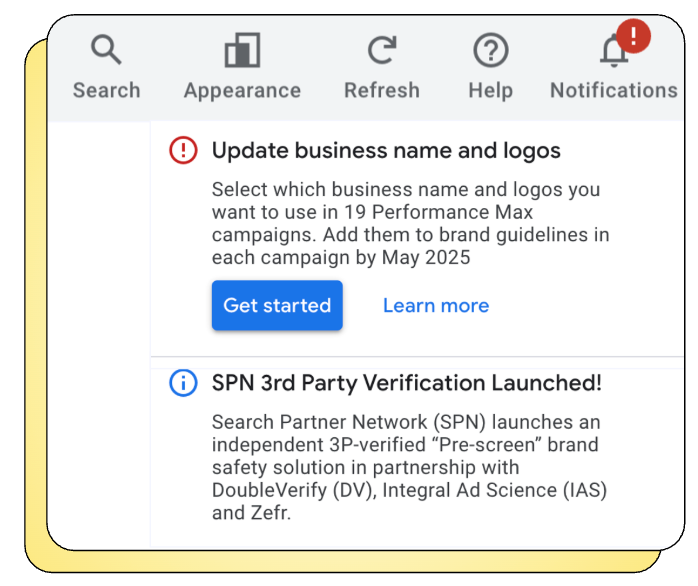
There’s a specific notification some of you may have seen and many more probably scrolled right past. It’s a small alert that reads something like: “SPN 3rd Party Verification Launched.” I’ve included a screenshot as an example because this is exactly the kind of thing that’s easy to overlook.
If you’re opted into the Google Search Partner Network for keyword-based text campaigns, that network is now meaningfully more transparent after the fact. You can pull placement reports, upload blocklists, and even integrate third-party pre-screening or brand safety solutions.
This is fairly new, and it’s not something Google has been shouting about from the rooftops for various reasons. I’m not going to get into the details, but if you know, you know.
What surprises me is how few advertisers are actually taking advantage of this. If you’re already running on Search Partners, you should be managing them the same way you manage search queries: reviewing placements, identifying issues, and excluding where necessary. And if you aren’t running Search Partners, it may be worth revisiting now that you have controls that didn’t exist not that long ago.
3. Treat RSA “Excellent” as the starting line, not the finish
Search marketers are task-driven people. Give us a target and we’ll optimize toward it. With responsive search ads, that target is getting Ad Strength to “Excellent,” and it feels genuinely good when you get there.
But hitting “Excellent” is not an optimization. It’s the starting line. Once you’re there, the real work begins.
- Review brand strategy – see if there’s something else you should add to your ad assets
- Identify growth targets – see if there’s a headline or something in your RSA you can rewrite or update to closely align with what your business is trying to drive (margin, category push, new customer growth)
- Rotate in new headlines systematically: you hit excellent, great, lets test whats next and then
- REPEAT
Whether you like it or not, RSAs are never “done.” They’re a living system, and the advertisers who treat them that way consistently outperform the ones who stop once they see a green label.
4. Use Smart Bidding Exploration strategically (not always-on)
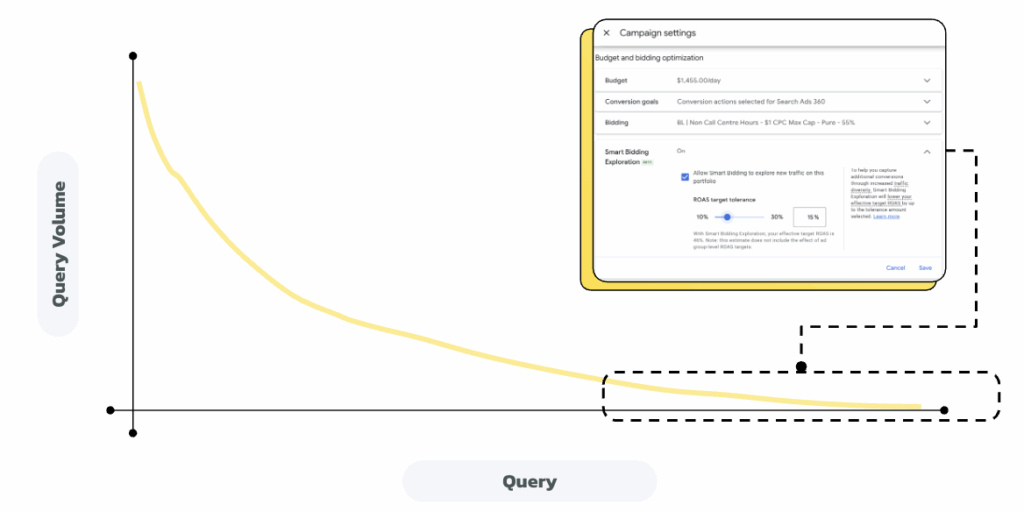
Smart Bidding Exploration had a big moment when it launched. Then, like many new features, it quietly faded into the background.
I don’t think this is something you should have turned on all the time. It’s not an evergreen setting. But it is a tool you should understand and keep in your pocket.
Smart Bidding Exploration allows you to set a tolerance around your performance thresholds—ROI or CPA—and then pursue incremental conversions that may be slightly less efficient than your current baseline. That makes it particularly useful when you have extra budget, need to make up incremental volume, or want to expand without blowing up your core strategy.
The key is intentionality. This is something you turn on for a reason, and it’s important to remember this feature when the opportunity to leverage it presents itself.
5. Data exclusions are not optional in an automated world
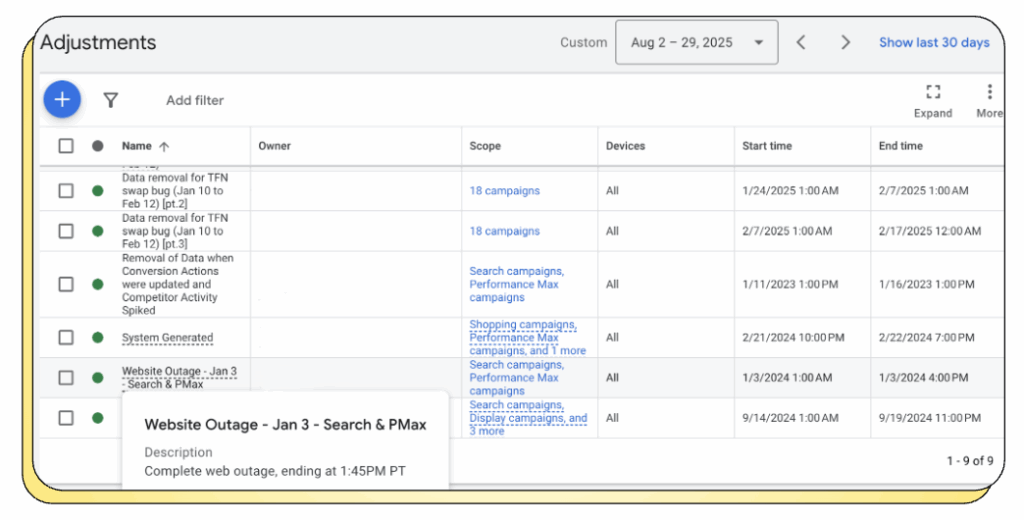
Whether you signed up for it or not, being a modern search marketer means being a data custodian.
Google’s conversion tracking is powerful, but it isn’t perfect. Tags break. Websites go down. Imports get delayed. CRM uploads fail. Every account experiences this at some point.
Any time your conversion data is compromised, you need to add a data exclusion for those dates.
This matters more than many people realize. As bidding and targeting become increasingly automated, the system relies on clean data to learn correctly. If your site is down for a day and you don’t exclude it, the algorithm looks at everything it tested during that window and concludes that nothing worked. It then optimizes away from those learnings.
In an automated ecosystem, protecting data quality is protecting performance.
6. Use labels like an operator (for tests, reporting, and sanity)
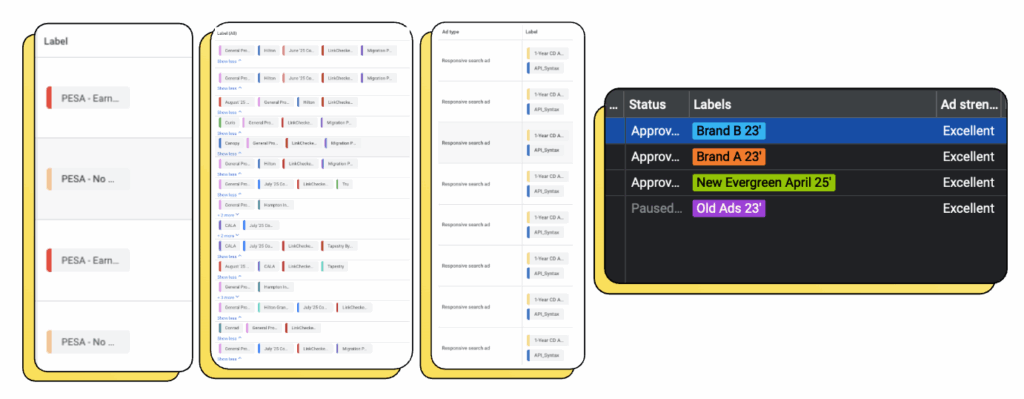
If you want one simple habit that makes every other optimization easier, it’s this: use labels intentionally and consistently.
Labels are flexible, lightweight, and criminally underutilized. They let you mark launches, flag tests, segment reporting, and organize analysis without interfering with bidding or forcing you into painful naming conventions. They don’t break automation. They don’t clutter your account. And if you’re using automated reporting, they’re accessible via the API.
But the real reason to use labels is speed and clarity.
In an account driven by automation, things change constantly. Labels let you answer questions like “What changed?”, “When did we test this?”, and “What was live when performance shifted?” in seconds instead of digging through weeks of notes, emails, or Slack threads.
They’re simple. They’re boring. And they quietly solve some of the biggest operational problems in modern search accounts.
7. Don’t write off AI Max just because early results are messy
I know some of you are tired of hearing about new AI products. I get it. But AI Max deserves more nuance than an immediate thumbs down.
In early tests, it’s not blowing the doors off performance. That’s fine. New products rarely do.
Two things are worth keeping in mind. First, Google is extremely good at building products and even better at improving them over time. Performance Max is the obvious example. Second, AI Max today is primarily about incrementality. It’s designed to find additional conversions by expanding keywords, testing new creative, and exploring new landing pages.
It’s not meant to replace your existing keyword campaigns, so judging it by identical ROAS or CPA benchmarks misses the point.
More importantly, as AI-powered search experiences continue to grow, products like AI Max are very likely to be how ads get optimized for those environments in the future.
8. AI Max is also one of the best bridges we’ve ever had between paid search and SEO
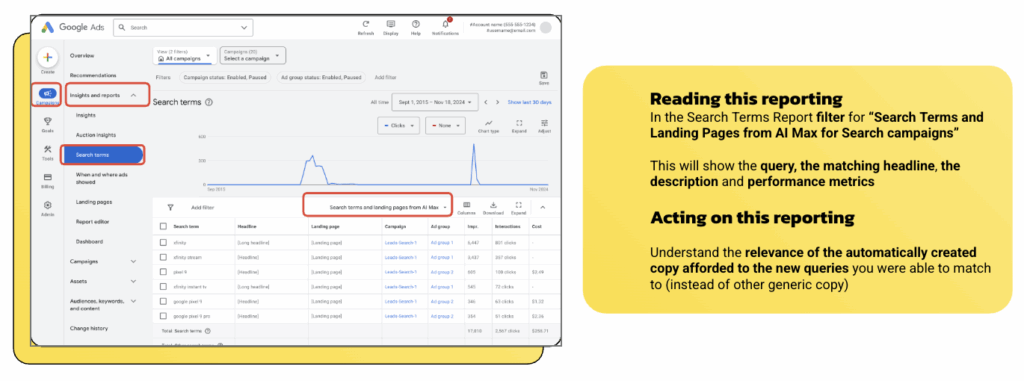
This is the part that genuinely excites me.
Under the hood, AI Max provides a level of control and transparency at launch that we rarely see. You can pull search terms, analyze automatically generated assets, review landing pages, and apply sophisticated exclusions and filters.
But the most valuable insight is how it connects queries, ad copy, and landing pages. AI Max can show you which queries matched which headlines and descriptions, and which landing pages Google believes are relevant.
That tells you what Google thinks a page is about and which queries it believes that page can satisfy. That information is incredibly valuable to SEO teams, and it’s been largely unavailable until now.
If you want integrated search to be more than a buzzword, this is where it starts. Share your best and worst paid queries with SEO. Look at organic landing pages that are performing well and see whether paid search is using them effectively. Talk regularly not because it’s magical, but because it’s hard work that pays off.
9. Use NotebookLM to turn messy inputs into usable outputs
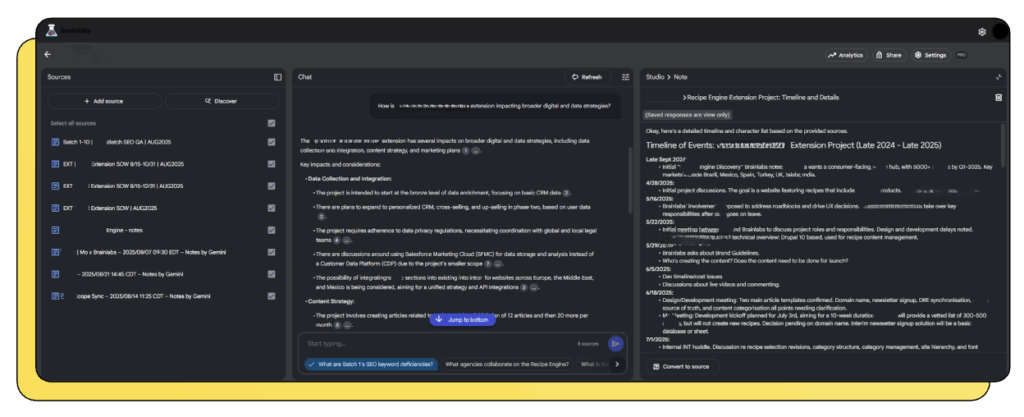
There’s a lot of AI out there that feels impressive until it suddenly doesn’t. That wobble is unsettling.
NotebookLM is different because it’s grounded in a corpus you control. Instead of pulling from the entire internet, it works only with the documents you give it: briefs, emails, call transcripts, notes, and plans.
The practical tip is this: use NotebookLM as a structuring tool, not a decision-maker.
Dump in messy inputs—long calls, scattered notes, email threads—and have it produce a first pass: a summary, a workback plan, a set of priorities, or an outline. Then have a human step in to shape, sanity-check, and finalize it.
The meta-skill that keeps you valuable: curiosity
Automation is powerful, but it optimizes based on what it can see in the rearview mirror.
Humans still own:
- what to test next
- where to expand
- what new opportunities matter
- how to translate business priorities into what “good” looks like in-platform
If you want one skill to protect and grow your value as AI takes over execution, it’s this:
Curiosity.
Curiosity prevents stagnation. Curiosity finds growth that the machine won’t.
A final reminder: don’t freeze your opinion after the first impression
Broad match is a perfect example.
For years it was unreliable. Then Google rebuilt it with modern AI systems—and now, in many accounts, it can perform extremely well if conversion data quality is strong.
The takeaway: don’t let your first impression of a new feature become permanent doctrine.
Try it. Learn it. Re-test it later.
Because the platform will change, whether you do or not.