

Ad creative is the biggest driver of paid media performance, but for years it’s also been the hardest thing to measure.
That’s the problem we set out to solve when we built Creative Intelligence. Already running across dozens of sophisticated advertisers in our client base, it pulls creative analysis and performance data into one place so you can see exactly what’s working and why.
In this piece, Jordan Taylor, the engineer who built it, and Shirin Bucknam, the creative strategist deploying it with clients, walk you through what it does and how it’s changing creative strategy.
The real creative measurement problem
The volume of creative being produced has never been higher. AI tools and platform best practices have pushed advertisers to produce more variants than ever, testing different formats, hooks, messaging angles, and visual styles across every campaign. That’s not a bad thing. But it’s created a problem nobody had to deal with when teams were running simple A/B tests: when you have hundreds or thousands of active creatives in market at any one time, figuring out what’s actually driving performance becomes exponentially harder, not easier.
Meta is already doing something sophisticated on its end. Its algorithm is analyzing thousands of signals to decide which ad to serve to which person at which moment. Creative Intelligence is built to reverse engineer that. By isolating the specific creative variables that correlate with performance across your portfolio, it gives you the same granular read on your creative that the platform already has.
Creative Intelligence: breaking creative down into its parts
Creative Intelligence pulls in creatives from Meta (with all platforms to follow in late Q2), uses AI to identify and categorize every element across each asset, and aligns those signals with your actual performance metrics. The goal isn’t just to tell you what performed. It’s to tell you which specific creative components drove that performance, and what to do about it.
The analysis operates across four dimensions: style and format, people and product, content and messaging, and CTA and offers. For video, every individual hook is broken down by timestamp, capturing the visual detail on screen, the text, the audio, the emotional trigger, and whether the product is visible at that exact moment. All of that feeds back into dashboarding you’d recognize, organized through AI tags and surfaced as specific, statistically validated recommendations.
The result is a single environment where creative decisions and performance outcomes exist in the same place.
What the AI surfaces that you couldn’t see before
Hook intelligence
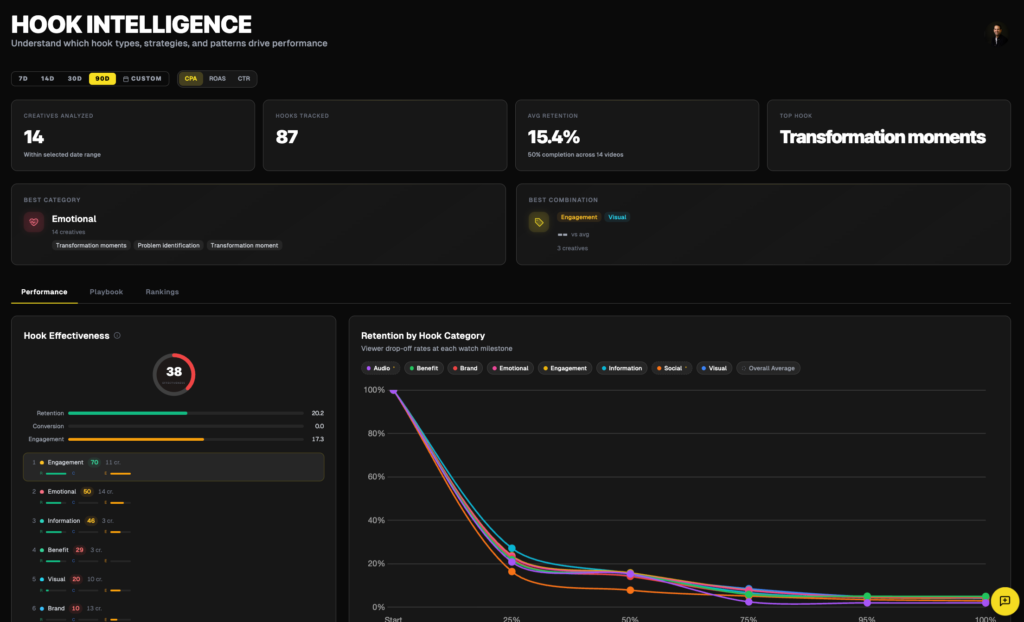
The first few seconds of a video ad are where most performance is won or lost, and Creative Intelligence breaks down every video by timestamp to show you exactly what’s happening at each moment. The type of hook, the visual detail on screen, the emotional trigger, whether the product is visible yet, all mapped to the exact second it occurs.
Across your portfolio, the platform identifies which hook categories are driving retention, which are driving conversion, and which are driving engagement, and shows you the combinations that are working best. So instead of a general sense that emotional hooks perform well, you know that transformation moments are your top hook type, that engagement and visual combinations outperform everything else, and exactly which creatives are proving it.
AI-driven insights and recommendations
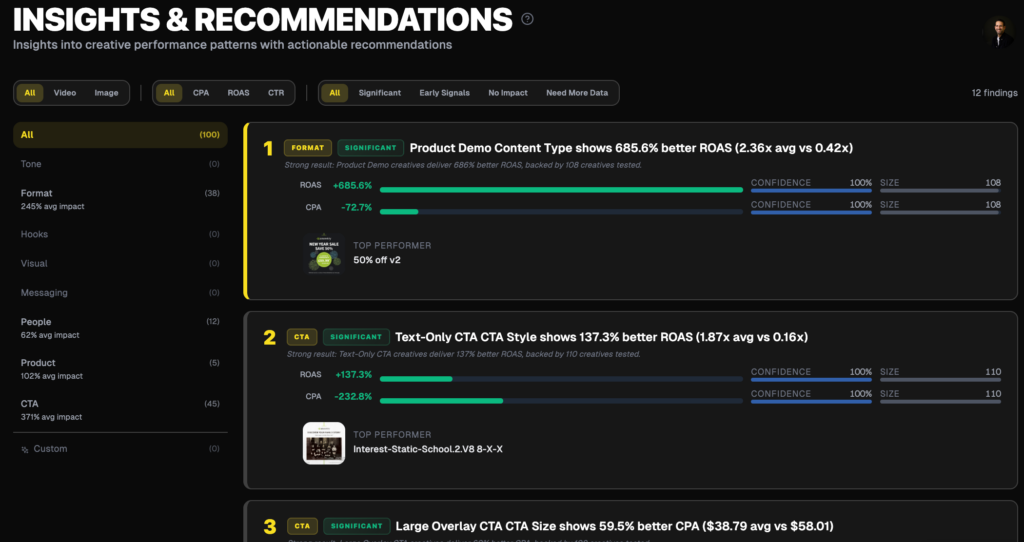
This is where the tool moves from analysis to direction. Creative Intelligence runs statistical analysis across your entire creative portfolio, surfaces the patterns that have enough volume behind them to be reliable, and tells you exactly what they mean for your next brief.
The findings are ranked by impact and validated by confidence score and sample size. So you’re not acting on a correlation from three creatives. You’re acting on findings like: product demo content delivers 685% better ROAS backed by 108 creatives tested, at 100% confidence. Or that a text-only CTA style drives 137% better ROAS across 110 creatives. The AI doesn’t just surface what’s working. It tells you by how much, how confident it is, and which creative is your top performer in that category.
Portfolio-level pattern recognition
Creative Intelligence tags every asset automatically on onboarding, across dimensions like tone, visual style, emotion, pacing, and messaging approach, with the option to add your own custom tags on top. Those tags are then aligned with performance metrics across your full portfolio so you can answer questions like: does a minimalist visual tone outperform high-energy across your awareness campaigns? When is the optimal moment to introduce a benefit claim? Which content type is driving the strongest return?
AI-generated creative briefs
The briefing capability is where this becomes most tangible for creative teams. Creative Intelligence generates creative strategy reports directly from your portfolio data, analyzing what’s working, surfacing hypotheses worth testing, and producing briefs grounded in evidence from your own performance history rather than received wisdom or platform best practice. It also pulls in industry benchmarks for context, so the brief is set against what’s working in your category, not just what’s worked for you.
Custom analysis for brand-specific questions
Not every insight lives in a standard taxonomy. The custom analysis feature lets you define your own variables: identifying which specific product lines appear in which creatives, scoring assets against brand-defined criteria, extracting information particular to your category or portfolio structure. Where manual tagging across thousands of assets would take weeks, the AI does it in minutes.
What this changes in practice
Most creative briefs are built on a combination of platform best practice, category convention, and whatever performed well in the last campaign. It’s a reasonable starting point, but it means creative strategy is always partially working from received wisdom rather than your own data.
When Creative Intelligence is running across your portfolio, that changes. The brief becomes an output of analysis rather than an input to it. You know which hook types are driving retention for your audience. You know which content formats are delivering the strongest ROAS. You know whether your high-energy creative is actually converting or just generating cheap clicks. The creative team gets direction that’s specific, evidence-backed, and connected to the metrics that matter, built from what the data is actually saying rather than what anyone remembers working last quarter.
Bottom line
Creative has always generated data. The problem has been that those signals were invisible at scale, buried in the gap between the creative suite and the performance dashboard. Creative Intelligence closes that gap, not by replacing creative instinct, but by giving the people with that instinct a clear read on which components are actually driving performance and what to do next.
If creative is the biggest driver of paid performance, it deserves the same analytical rigor you apply to everything else. Now it has it.
Want to see what Creative Intelligence surfaces in your own portfolio? Get in touch.